


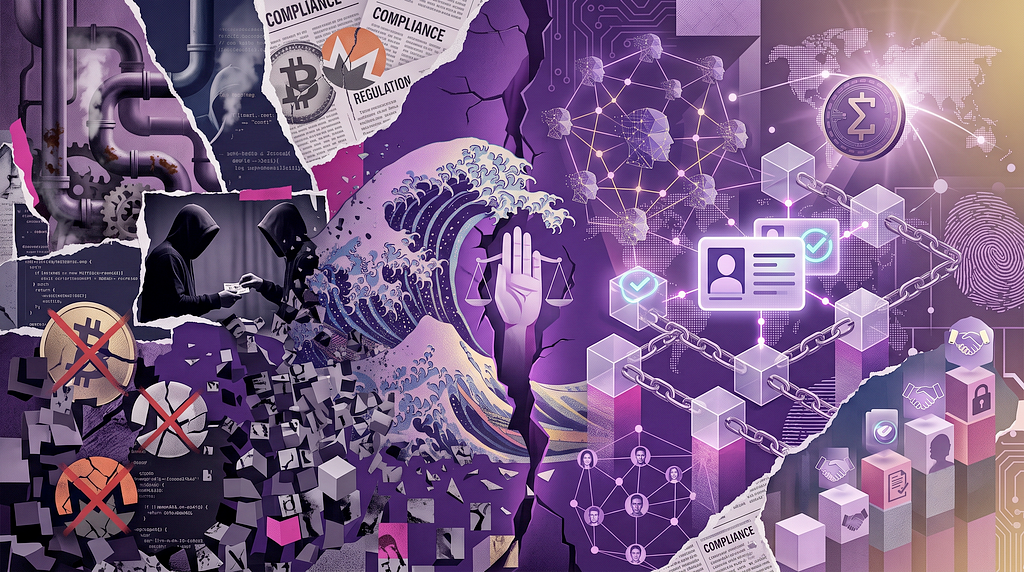
1. When Crypto Assets Are No Longer “Niche”
For years, crypto’s relationship with regulation was defined by avoidance.
Builders optimised for permissionless access. Users sought decentralised networks. Products competed on who could remove the most friction. The fewer intermediaries, the better. But that narrative is beginning to change.
On 4 June, both SafePal and Bitget Wallet announced that their banking partner, Fiat24, would suspend new account openings for users in certain regions. Predictably, the community scrambled. Some rushed to complete their applications before the deadline. Others immediately started looking for alternatives. But if all we see is the loss of another crypto card, we’re missing the far bigger story unfolding beneath the surface.
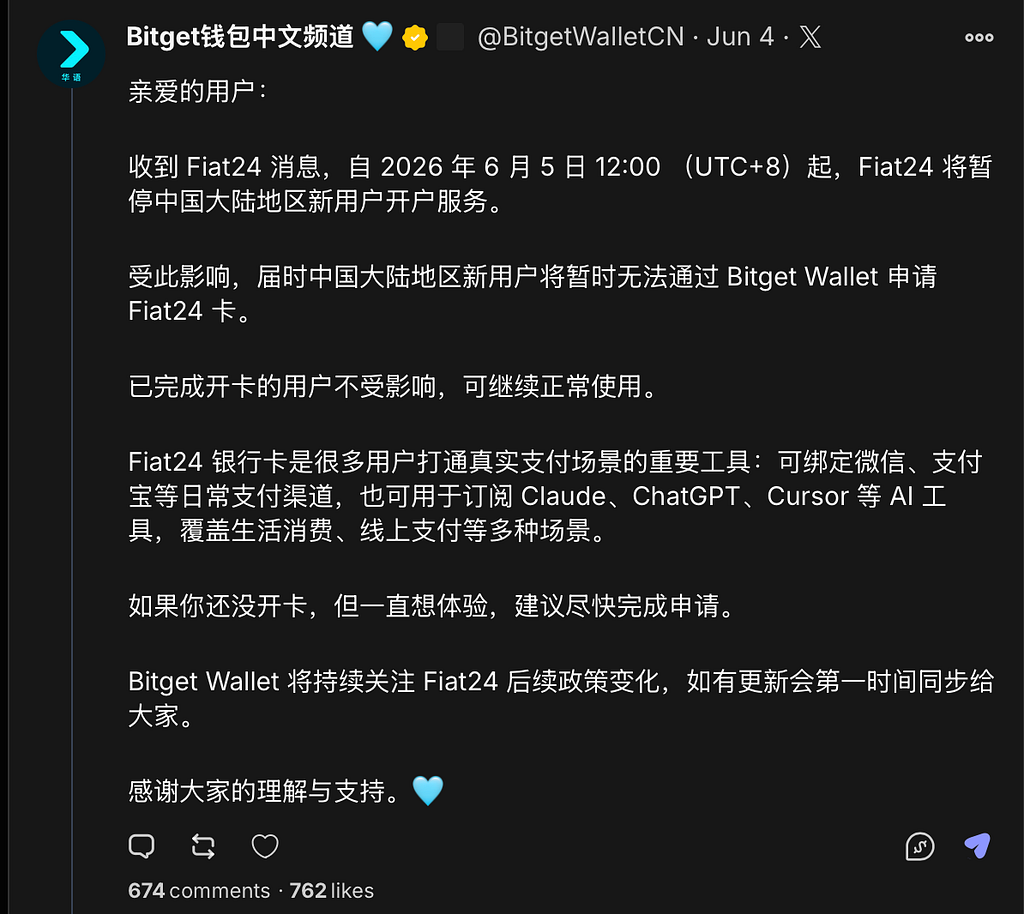
Source: Bitget X Account
Fiat24 is hardly an isolated case. Over the past two years, the crypto card industry has gone through an aggressive wave of consolidation:
- September 2024: OneKey, one of the earliest crypto cards popular in the APAC region, halted new registrations and top-ups, officially shutting down in January 2025.
- June 2025: Infini exited the consumer card business, admitting that retail cards consumed 99% of operating costs while generating almost no revenue, prompting a full pivot to B2B.
- November 2025: Crypto card provider Dupay ceased operations entirely, citing insurmountable compliance and payment settlement challenges.
- February 2026: Mastercard terminated UnCash’s “KYC-free” card channels, a move the company described as an existential blow to its business model. A sweeping purge of grey-area crypto cards had officially begun.
These closures were never simply operational failures. They reflect a profound paradigm shift: Crypto is no longer being treated purely as a speculative asset class. It is increasingly becoming part of the global financial system.
That transition inevitably eliminates businesses built around regulatory gray areas, but it also creates enormous opportunities for infrastructure designed to operate within regulated financial frameworks.
And that changes the rules of the game.
2. Regulation Is No Longer Chasing Crypto. It’s Preparing for It
For most of its history, crypto existed largely within its own ecosystem. People traded tokens, farmed yields, rotated between DeFi protocols, and speculated on memecoins. Regulators largely responded reactively, focusing on exchanges, AML enforcement, and fraud prevention.
But Consumer Crypto changes the equation. Today, stablecoins can pay for groceries. Crypto cards can settle restaurant bills. Tokenised assets can generate yield. Cross-border payments settle in seconds. Wallets increasingly resemble bank accounts. The industry no longer asks users to “live on-chain.” Instead, it is quietly integrating into everyday financial life.
Once that happens, regulators stop asking whether crypto should exist. The question becomes how it should coexist with the existing financial system. The conversation has shifted from prohibition to integration, and that philosophical shift is now translating into policy.
Within a single week in July 2026, three major jurisdictions revealed remarkably similar directions:
- Europe (MiCA enters full implementation): Following the end of the transition period, more than 90% of Europe’s 3,000+ crypto companies were phased out, leaving only 244 approved entities. According to Kaiko, licensed platforms including OKX, Kraken and Coinbase now account for roughly 83% of trading volume. Meanwhile, Binance, lacking the necessary licenses, has been forced to scale back operations across several European countries.
- Australia (Travel Rule becomes mandatory): Aligning with US and EU standards, AUSTRAC-regulated exchanges must now verify sender and recipient information for all digital asset transfers, regardless of transaction size, beginning 1 July.
- United States (Project Crypto): Rather than introducing restrictive rules, the SEC has focused on regulatory modernisation. Following President Trump’s executive order directing agencies to review digital asset regulations on 19 May, SEC Chairman Paul Atkins announced new efforts to provide long-term regulatory certainty and equal treatment for digital asset issuers on 30 Jun.
Three jurisdictions, three different approaches, but pointing to one shared conclusion: Crypto is no longer a lawless frontier. While many users see additional compliance friction, institutions see predictable rules. Predictable rules reduce operational risk, increase confidence, and attract capital. After all, no one deploys trillions of dollars into a black box filled with uncertainty.
The next wave of adoption is unlikely to come from products avoiding regulation.It will come from products designed for regulated markets. Compliance itself is becoming infrastructure.
3. The More Useful Crypto Becomes, the More Regulation Follows
As crypto shifts from onboarding users into Web3 toward embedding itself into everyday finance, regulators inevitably begin asking practical questions: Who is spending the money? Where did the funds originate? How should they be taxed?
These questions are becoming increasingly important across two of crypto’s fastest-growing sectors.
3.1 Consumer Crypto: Compliance Reefs Beneath a Simple UX
Crypto cards are the frontline of this social experiment. Products like Fiat24, KAST, Ether.fi Cash, and various exchange-issued cards allow users to spend stablecoins almost anywhere Mastercard or Visa is accepted. As discussed in our previous article, adoption has accelerated dramatically. According to Artemis Research, monthly crypto card volume grew from roughly $100 million in early 2023 to over $1.5 billion by the end of 2025, with 211% year-over-year growth recorded in March 2026.
For users, the experience feels simple. Deposit USDC. Tap the card. Pay. Behind that simplicity, however, sits infrastructure increasingly resembling traditional banking. Many crypto cards now offer IBAN accounts, FX conversion, cross-border transfers, and banking services. As these products mature, compliance requirements inevitably follow. Conversations around tax reporting, Common Reporting Standard (CRS), capital control and cross-border financial disclosure begin to emerge.
Fiat24’s recent restrictions illustrate this perfectly: As a regulated financial institution, it required customers to submit Tax Identification Numbers (TINs) to comply with CRS-based international information sharing.
This also explains why so-called “no-KYC crypto cards” have little long-term future. Regardless of how they are marketed, any card connected to Visa or Mastercard’s settlement network ultimately requires traceable end-user identities. Many of these “anonymous” cards simply relied on shell companies to issue corporate employee cards to retail users. The moment regulators scrutinise those structures, they quickly fall apart.
The lesson is straightforward: As crypto payments evolve from niche experiments into mainstream financial products, regulatory oversight is no longer optional. Higher compliance standards are eliminating businesses built on arbitrage. Only by embracing compliance can projects become enduring infrastructure.
3.2 The Same Pressure Is Moving Toward RWA
For years, RWA (real world assets) was primarily associated with tokenised U.S. Treasury bills. Today, Tokenized equities are becoming increasingly viable. Private credit continues growing. Exotic RWA, including trading cards (TCG), luxury collectibles, fine art and cultural memorabilia, are rapidly moving onchain.
According to RWA.xyz, tokenised RWAs (excluding stablecoins) surpassed $32 billion by mid-2026, representing more than a fivefold increase since early 2025. BlackRock and Securitize’s BUIDL fund alone has grown to nearly $2.3 billion.
Source: RWA.xyz
Exotic RWAs are seeing similar momentum. In the TCG sector, Polygon’s Courtyard generated $17.75 million in revenue in Q2 2026, while Collector Crypt reached $32.37 million. Emerging platforms like BNB Chain’s Renaiss Protocol are also booming, surpassing $20 million in revenue within six months of launch, with secondary market trading accounting for 23% of volume. The Exotic RWA space warrants a standalone deep dive, which we have covered in a previous article.
From a technical perspective, tokenisation is no longer the industry’s biggest challenge. Institutional adoption is. Across major financial markets, regulatory frameworks are taking shape: the EU has folded most RWAs into MiCA. Hong Kong is opening doors for public issuance and trading, and the U.S. SEC maintains that most profit-expectant RWA tokens are securities, demanding strict registration and disclosure.
Yet even with regional regulatory frameworks emerging, the industry’s biggest challenge remains unresolved.
The long-term vision of RWA is straightforward: Any asset can become programmable and globally transferable. But the moment those assets cross borders, regulatory complexity explodes. Consider this: If an investor in Southeast Asia purchases tokenised U.S. equities, or fractional ownership of a rare Pokémon card, whose securities law applies? Which country collects taxes? Who resolves disputes?
Ultimately, the more successful RWA becomes, the more identity becomes unavoidable. When real-world assets go onchain, proving “who you are and what you own” is no longer a philosophical debate. It is a hard compliance constraint.
4. The Next Bottleneck Is Not Liquidity. It’s “Who Are You?”
Much of crypto’s infrastructure over the past decade focused on capital efficiency. DEXs improved liquidity. Rollups improved scalability. Stablecoins improved settlement. But as consumer payments and RWAs move into the mainstream, one uncomfortable reality is becoming impossible to ignore: The financial “highways” are built, but the assets “vehicles” cannot drive on them because they lack “license plates” (compliant identity and credit).
The next bottleneck is not liquidity. It’s identity. More specifically, identity and trust.
Nearly every compliance challenge eventually reduces to a simple question: Who are you? Yet, unfortunately, today’s answer remains fragmented. Users repeatedly upload passports across exchanges, wallets, banks and financial applications. Each platform maintains isolated identity systems. The result is poor user experience, higher operational costs, and duplicated compliance work. As consumer crypto and RWA continue scaling, the more obvious this fiction becomes.
The Fiat24 incident also exposed a less obvious problem. Users didn’t lose their assets, they simply lost access to a payment rail. But that highlights a deeper structural issue: today’s crypto payment infrastructure still treats users as passive “consumers” rather than active “participants”. Every payment settles, then disappears. Purchase history isn’t portable. Relationships with merchants don’t persist. Years of responsible onchain activity rarely become part of a user’s identity or reputation.
This is where crypto still falls short. The industry has become remarkably good at moving value, but not trust. The problem isn’t that users lack credibility. It’s that their credibility cannot be seen, verified, or carried across applications. Traditional finance solves this through centralised systems like FICO, but that model sits uneasily in a decentralised, privacy-first ecosystem.
Viewed through that lens, today’s regulatory shift becomes much easier to understand. The real opportunity isn’t simply complying with new rules. It’s building a portable trust layer that makes compliance more efficient without sacrificing user ownership.
5. This Is Where DeSoc Actually Becomes Interesting
Traditional KYC was never designed for an interoperable internet. It cannot move across platforms and creates centralised honeypots of sensitive personal data. What crypto increasingly needs is something more composable: A trust layer built from real user interactions.
This is exactly where Decentralised Social (DeSoc) becomes far more important than most people realise.
DeSoc is often dismissed as “X (Twitter) on blockchain.” But earlier this year, Ethereum co-founder Vitalik Buterin identified decentralised social as one of the application categories he most hopes builders will focus on. The reason is not because the world needs another social network, but because portable identity is foundational to an open internet. The true value of DeSoc doesn’t lie in the act of “socialising”; rather, lies in building portable reputation, something regulated crypto increasingly requires.
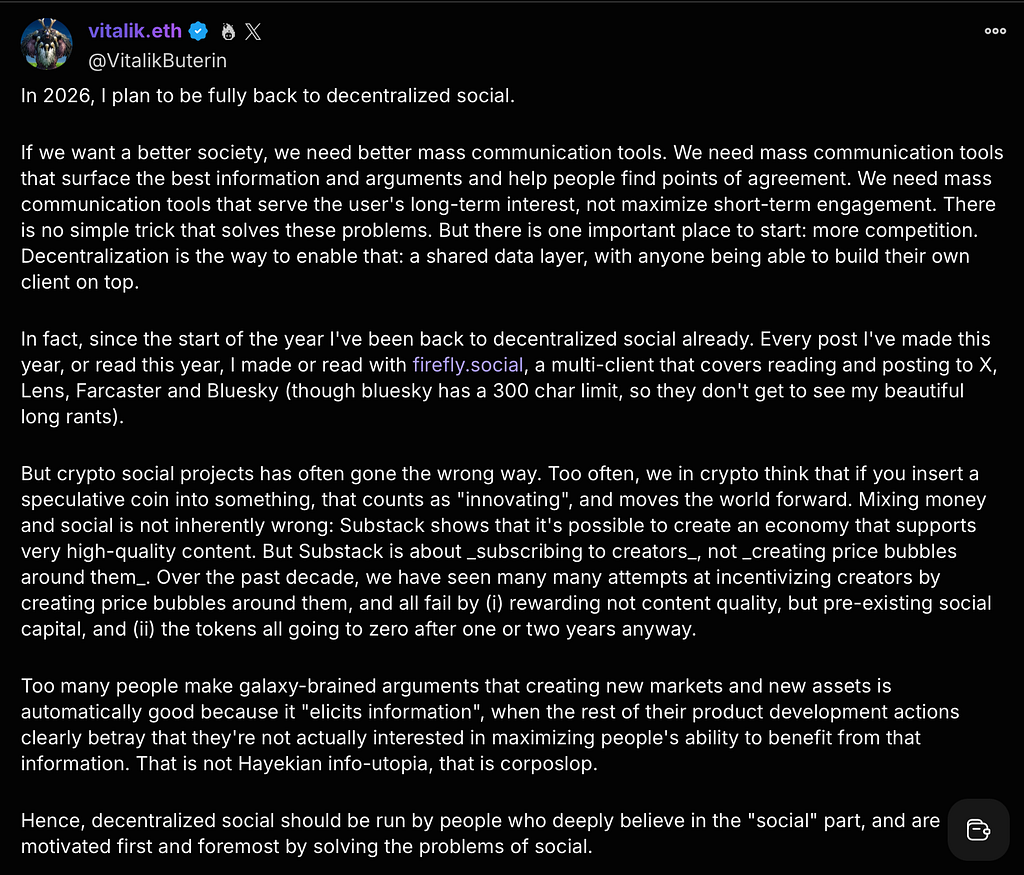
In early 2026, the DeSoc sector underwent a core pivot: stewardship of Lens transitioned to Mask Network, while Farcaster was acquired by Neynar. This “passing of the baton” revealed a critical shift: DeSoc was moving beyond token incentives and social experiments toward practical identity infrastructure, transforming everyday onchain activity into portable, verifiable reputation.
For this trust layer to be usable, the infrastructure must solve three fundamental problems: identity resolution, semantic behaviour, and trust accumulation. Three projects illustrate this evolution particularly well:
- Web3.bio (Answering “Who are you?”): As an identity aggregator, it bridges information silos, merging fragmented IDs from ENS, Farcaster, and Lens, along with wallet addresses, NFTs, and POAPs, into a unified profile. It acts as a “Web3 Identity Map,” turning identity displays directly into social connections and forming the verifiable baseline for social credit.
- Firefly (Answering “What do you stand for?”): It gives behaviour meaning. By aggregating content across X, Lens, Farcaster and Bluesky, alongside Mirror articles, Snapshot governance activity and Polymarket predictions, it transforms raw blockchain activity into meaningful social context, a crucial dimensions for credit evaluation.
- Orb (Answering “Who trusts you”): Built on Lens, it encourages high-frequency community participation through lightweight, gamified interactions. Every conversation strengthens social reputation rather than simply producing engagement metrics.
Together, these projects represent an important shift. Rather than forcing users to create new social graphs, they make existing onchain relationships visible, portable, and verifiable, transforming them into trust assets. At its core, this new form of social credit is not a score issued by a central authority, but a bottom-up social consensus built from identity, participation, and reputation.
Imagine a future user who has aggregated identities through Web3.bio, established governance preferences through Firefly, and accumulated years of community participation on Orb. When applying for a crypto card or participating in RWAs, the issuer doesn’t demand repeated passport uploads. Instead, institutions evaluate verifiable reputation credentials (VCs). Users retain data sovereignty, platforms ensure compliance, and regulators get an auditable trail.
This trust layer will not, and should not, replace government-issued KYC. But it can dramatically reduce the friction between users and regulated financial services. This is the new paradigm of Consumer Crypto: every payment and interaction adds to your onchain reputation, while your social relationships become a natural endorsement of your credibility.
When identity and credit data belong to users, they are no longer defined by platforms. They become self-sovereign individuals who own and shape their digital identity. We explore this vision of decentralised social in a separate, detailed article.
6. The Future May Require a New Social-Financial Layer
Crypto’s next chapter is unlikely to be defined by how effectively it avoids regulation. Instead, it will be defined by how elegantly it builds around it.
With this understanding, looking back at the recent wave of news paints a completely different picture. Taken individually, these events look like regulatory tightening. Viewed together, however, a grand narrative emerges: Major global economies are synchronously building a clear, predictable, and interoperable regulatory framework for crypto assets.
This is not crypto’s doomsday. It is an irreversible coming-of-age ceremony.
Consumer Crypto solves “how to spend”, RWAs solve “what creates value”, and DeSoc solves “who you are” and “how much you are trusted”. The three naturally converge, forming a potential framework for the next phase of digital social economies: A Social-Financial Layer underpinned by onchain reputation and trust.
Within this super-identity layer, three pillars reinforce one another:
- Asset Layer (RWA): Provides a quantifiable financial balance sheet (What you own)
- Payment Layer (Consumer Crypto): Provides dynamic behavioural cash flow (How you spend)
- Identity Layer (DeSoc): Provides social reputation backing (Who trusts you & who you influence)
The convergence of these three layers gives rise to a new form of composite onchain social credit. Imagine a user who holds tokenised Treasuries, pays recurring bills with a crypto card, and actively participates across decentralised communities. Even while remaining pseudonymous, a DeFi protocol could verify their trustworthiness through Zero-Knowledge Proofs (ZKPs) and extend unsecured credit or preferential borrowing rates.
Here, compliance and trust are no longer rigid barriers to entry. They become natural outcomes of onchain behaviour.
The industry’s challenge is no longer simply scaling transaction throughput, but scaling trust. Fiat24’s restrictions and Binance’s retreat may look like regulatory tightening, but they actually signal the end of an era built on regulatory arbitrage and fragile payment rails. Projects relying on regulatory arbitrage and fragile payment channels will disappear.
As every payment and interaction accumulates into portable social credit, users no longer depend on access. They carry their own trust. That is the real moat. The projects building identity and trust infrastructure today will be the first stop for the next wave of capital moving onchain.
Compliance is not the threat. It is the catalyst.
And regulation is not the finish line. It is where crypto’s next era begins.
【免责声明】市场有风险,投资需谨慎。本文不构成投资建议,用户应考虑本文中的任何意见、观点或结论是否符合其特定状况。据此投资,责任自负。