


There Is No Risk-Free Yield in DeFi: A Conversation with Spark.fi’s Monet Supply — Gate Ventures Podcast EP.5

Gate Ventures Podcast EP.5 Guest: Monet Supply, Head of Strategy at Spark.fi
The past six months have been expensive for DeFi. The rsETH exploit, the Stream Finance blowup, and a steady drip of “stable but high-yielding” products losing their peg have forced the market to confront a question that high APYs had been papering over for years: what exactly is our money sitting inside?
For the fifth episode of Gate Ventures’ Podcast, we sat down with Monet Supply, Head of Strategy at Spark.fi. He started his career in traditional finance and fintech, pivoted into DeFi around 2020, and spent roughly five years at the risk consultancy Block Analytica before joining Spark. His mandate today is split roughly evenly between hunting opportunities and stress-testing them.
What follows are the ideas from that conversation we think every DeFi allocator and builder should sit with.
1. The first number he checks every morning is liquidity
We asked Monet: as Head of Strategy, what is the first metric you look at when you wake up — the one that would genuinely scare you if it moved the wrong way?
He didn’t hesitate: remaining liquidity. In Spark.fi’s own savings vaults, in Sky’s PSM, and in every external protocol Spark has allocated into.
“Liquidity is what users depend on to be able to get in and out. If there’s no liquidity, you can’t get out. So if we see an allocation we’re making and the amount of liquidity is going down, that’s the exit door slowly closing.”
There are plenty of other things to watch, but withdrawal capacity is the single signal that puts him on alert. That framing tracks directly with how DeFi’s user base has changed. The people allocating on-chain today aren’t depositing ten or a hundred thousand dollars — they’re depositing ten million, a hundred million. Different scale, entirely different demands on the exit.
2. Yields compressed. DeFi’s value proposition changed with them.
Monet is blunt about where we are in the cycle: yields across DeFi have compressed substantially. The Sky Savings Rate and most Spark.fi savings products now pay roughly the U.S. Treasury bill rate. In the genuinely safe corners of DeFi, meaningful excess return is gone.
So what’s left? He points to three things:
- Liquidity — you can get in and out quickly, with no waiting on wire transfers to land.
- Speed and flexibility — moving capital between TradFi and on-chain carries very little friction.
- Access — for users without a brokerage account that can reach the U.S. risk-free rate, DeFi is the on-ramp.
“It’s a different value prop than we had two or three years ago, when our yields were a few percent above the risk-free rate. The way we align our product has to adapt to who our users actually are and what benefit we’re genuinely able to offer them.”
The implication generalizes across the industry: when the alpha disappears, infrastructure quality and safety become the only differentiation left.
3. From idealist to realist
Monet is candid that his own thinking has shifted. When he entered in 2020, he believed — like many did — that DeFi would replace TradFi outright: no intermediaries, everything on-chain, everything perfectly trustless. Five years ago, using a custodian or a trusted service provider in a protocol’s workflow would have struck him as simply unacceptable.
The data from the last six months turned him into a realist:
“We’ve seen a lot of code exploits, a lot of DeFi hacks of various kinds. And when you look at custodians or trusted service providers, there are far fewer hacks — and the ones that happen have really big balance sheets behind them, so they can backstop them much more quickly and with more assurance.”
He frames this not as abandoning decentralization but as recognizing that trustlessness is itself a trade-off. The work is finding the right balance, not pushing any single principle to its logical extreme.
4. The concentration problem: DeFi is really only running three trades
On the surface, DeFi offers endless assets — stablecoins, liquid staking tokens, every flavor of wrapped Bitcoin. Monet argues it collapses into three trades:
- Borrowing stablecoins against crypto (BTC / ETH);
- Borrowing ETH against liquid staking tokens (the loop);
- Borrowing one stablecoin against a yield-bearing stablecoin.
Together, those account for roughly 90–95% of DeFi lending activity.
Counterintuitively, he considers the first category systemically safer. Because the collateral and the debt are obviously uncorrelated, borrowers know the risk is real — they know a drawdown means posting more collateral or getting liquidated. That awareness makes them hold more excess collateral and approach the position more conservatively.
The looping trades are where it breaks:
“The debt and the collateral reference the same asset. It’s easy for people to get overcomfortable and treat it as a risk-free trade — ‘I can just lever it to the max.’ That becomes a problem when it’s not one person doing it, but the entire market doing it at once with a similar amount of leverage.”
The result is periodic mass unwind events: everyone tries to exit simultaneously, LST or yield-bearing stablecoin pegs break, and ETH borrow rates spike. During the rsETH episode, looped positions in other LSTs like Lido and ether.fi came under the same pressure.
He is careful to note: there is nothing inherently wrong with looping. The problem is how much leverage users take and how crowded the trade becomes.
Diversification is part of the answer. He notes Ethena expanding beyond crypto funding rates and T-bills into a broader RWA mix, and points to Aave V4’s architecture, which envisions specialized markets for real-world assets, CLOs, and T-bills alongside crypto. Spark.fi has run a diversified yield mix for years — DeFi lending, lending via custodians, funding rates, and more.
“If one of your trades has a risk event or unwinds, you can give it time to unwind slowly and in an orderly way. And if you need liquidity for depositors to get out, you can draw on the parts of your book that aren’t stressed.”
5. Separating risk-adjusted yield from the tail risk hiding behind it
This may be the most practically useful stretch of the conversation for both retail allocators and funds.
Monet offers two tests.
Test one: disclosure, accounting, and third-party verification are non-negotiable
“If you’re purely trusting the issuer to invest your capital, they have total discretion. Maybe they say the strategy is XYZ — delta neutral, a box spread, something like this — but you have no way of verifying it. You’re basically giving an unsecured loan to whoever this asset manager is. It’s pure trust.”
And here is the arithmetic that kills most of these products: the yield an issuer can realistically pay is almost never high enough to justify an unsecured, trust-based loan. The math simply doesn’t work.
So his first filter is: rigorous accounting, clarity on where the funds are actually held, and ideally a credible third party reviewing and attesting to it.
Test two: if it’s too good to be true, it usually is
He walks through several recent cases:
- STRC (issued by Strategy / MicroStrategy) — not a stablecoin, but designed for stable value plus high yield. It recently traded at a 10–20% discount to its target value.
- Stream Finance — the well-known blowup from last year.
- Main Street Finance — marketed a box spread strategy, a conventional options-based delta-neutral trade, as delivering 12%. The same strategy in traditional markets yields roughly 4%.
“Where is that extra money coming from? If the yield is very high, what’s the reason for it — other than somebody fudging the numbers? People should ask themselves whether it’s too good to be true.”
6. There is no genuinely risk-free yield in DeFi
Asked directly whether risk-free yield exists in DeFi, Monet’s answer is unambiguous: not today.
The closest approximations are tokenized T-bill products and plain-vanilla stablecoins backed purely by T-bills. Even there, the issuer could go bankrupt — you might get your money back, but only after the courts are done with it — or there could be minter keys, where the backing is fully intact but extra tokens get minted and the whole thing becomes a mess.
As for Aave, long treated as DeFi’s risk-free rate, he’s direct: the last two months proved it isn’t. Highly liquid, relatively stable by DeFi standards — but not risk-free.
Spark.fi’s stated goal is to get as close to risk-free as possible while being honest that it will never arrive. The approach rests on three things: proper disclosure and accounting so you know where the backing sits; broad diversification so no single basket matters too much; and capital buffers, so somebody else’s money always stands between the end user and a loss.
7. Spark.fi’s security and loss absorption framework — which pillar does the heavy lifting?
After the rsETH exploit, Spark.fi published a security and loss absorption framework built around five ideas:
- Bounded capital movement
- Explicit loss absorption layers
- Coordinated liquidity
- Multi-layered oracles
- Constrained automation
We asked which one does the most work. His answer was the first:
“Spark.fi isn’t like some protocols where the manager has full discretion to move the money where they want. The funds are held in a contract on-chain, and there’s a series of whitelisted places the money can move to. Each one has a rate limit on how fast money can move there, based on how risky it is.”
That produces a property that matters enormously:
“Even if we get completely hacked, or we get abducted by aliens, or we just go insane — any sort of thing that could happen to us — there are still hard limits on exactly where the money can move and how quickly. Governance can deauthorize us and put in a backup. The amount of damage from a key management failure is very limited.”
In other words, bounded capital movement is what lets users trust the product without putting 100% trust in the contributors behind it. It’s the foundation the other four pillars rest on.
8. rsETH: a lesson in subtraction
Spark.fi came through the rsETH incident clean. Until early 2026, rsETH was one of the collateral assets in SparkLend, and Spark also held allocations in Aave V3, which carried sizeable rsETH exposure.
Monet declines the credit:
“I don’t want to take too much credit, because we didn’t specifically identify the bridging of rsETH as the critical risk factor. Our calculus was a general review of the asset. Bridging was one factor, but so was how complicated the backing and the restaking aspects were. It’s a very high complexity protocol, and more complexity means more things that could go wrong.”
At the same time, rsETH wasn’t a major economic contributor to SparkLend. That made the decision easy: high complexity × low economic importance = turn it off. Several other collateral assets were disabled in the same sweep.
“Our philosophy is that we should be trying to subtract and get rid of as many things as we can, at all times. We didn’t see specifically that bridging was going to be the problem — but because we had the right mindset, we avoided it anyway.”
The takeaway for allocators: you can’t predict where the next exploit lands, but you can continuously shrink your own risk surface. If you can’t fully understand a product, you probably shouldn’t be in it.
9. Loss waterfall vs. shared insurance pool — why tranches?
Many DeFi protocols run a single shared insurance pool. Spark.fi runs a layered loss absorption waterfall, a decision made collectively at the Sky level (Spark.fi is a subDAO of Sky, with more to follow).
The order of absorption:
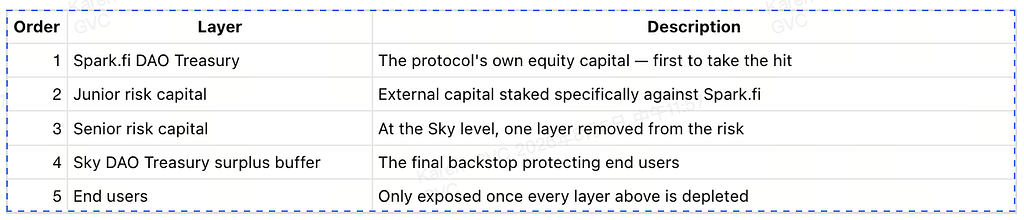
Three advantages fall out of this design.
Incentive alignment. Spark’s own treasury sits first in line, which gives the team a very strong reason to allocate safely. Get it wrong, and they eat the loss before anyone else does.
Optionality for outside capital. Investors choose their own risk: higher yield with first-loss exposure after Spark’s treasury (junior), or a few layers of protection with a return still above the Sky Savings Rate (senior).
Maximum protection for end users, who sit behind everything.
What does a senior tranche investor actually underwrite?
This is the question institutional capital cares most about, and Monet’s decomposition is sharp:
- Market risk — say BTC collateral falls faster than you can liquidate, and you recover 95 million on a 100 million loan — is a high-frequency, low-severity event. That takes a bite out of the junior tranche but likely never reaches senior.
- What does reach senior is tail risk, and it’s binary: a bridge gets hacked, a large protocol you’ve allocated into has an oracle failure. Either it doesn’t happen, or the whole thing is completely broken.
“So in a sense you have this layer of protection between you and the risk. But in practice what that means is you’re effectively not exposed to a certain class of risk, while still having almost the same exposure to the tail risks.”
Which makes this a genuinely interesting underwriting challenge — the layers differ in the nature of the risk, not merely the quantity.
10. Who buys the tranches? Yield funds may rotate out of looping
We asked who actually allocates to junior and senior tranches. Monet doesn’t expect large institutions — custodians and major exchanges that hold capital in DeFi tend to stay in the super-senior, lowest-risk layer.
The more likely buyers are the cottage industry of yield funds that spent the last couple of years looping yield-bearing stablecoins on Aave or Morpho to lever returns into the 10–20% range:
“Although you have elevated exposure to the solvency risk of whatever you’re invested in, you don’t have some of the other risk factors you get from looping — like interest rate risk, where the borrow rate you’re paying suddenly spikes above the yield on your collateral.”
He expects these specialized funds to shift part of their capital from looping into tranches: potentially better yield, without the structural problems of a crowded trade.
11. DeFi, CeFi, and RWA are three different risk animals
When capital sits across DeFi, CeDeFi, and RWA simultaneously, how do you compare the risks? Monet’s answer is more direct than expected:
“At least how it feels now, DeFi technical risk — especially for newer protocols that haven’t been live long — feels worse. I personally feel more afraid of being hacked in DeFi than I do of a major custodian losing my money.”
Part of the reason is AI: coding agents are finding exploits at an accelerating pace. He expects newer DeFi protocols to be a heightened concern over the next several months.
But he also sees DeFi’s structural advantage on a three-to-five-year horizon:
“It is possible to make code that has no bugs. I could see a future where we have open-source code, we’ve put the best AI agents and human auditors against it, we’ve formally verified it, and we’ve confirmed there are no bugs. This is perfect code — it does exactly what it says it’s going to do. Something like a custodian, although it’s safer now, is never going to reach that stage of perfection, because there are always humans in the process, and humans can always screw stuff up.”
For off-chain assets — RWAs, CeFi, CeDeFi — the core challenge is different: you can’t see the exact state of the system. You need attestations, oracle services, or accountants performing audits to get transparency, and you need to understand the legal structuring on top of that.
“A lot of people just assume: okay, there’s a token on chain that represents this, so it must be there. But no — you have to do all these other layers of due diligence when it’s off-chain.”
For anyone arriving from a purely DeFi background, that’s a major shift in mentality.
12. The next three to five years: infrastructure moves on-chain, assets move off
Monet’s forecast is deliberately two-sided:
- Infrastructure moves increasingly to smart contracts. Once code can be fully verified, even service providers like exchanges and custodians will rely more on code to control their business logic.
- The asset mix becomes more blended, not less. Alongside ETH, BTC, and SOL, dollar stablecoins, T-bills, and a growing set of tokenized equities are here to stay.
“I love a crypto-native asset more than anyone, but it would also be nice to trade the Mag 7 or the biggest major equities — to have them in your portfolio, to use them as collateral.”
In one line: infrastructure trends toward DeFi; the asset mix trends toward tokenized traditional finance.
13. The most underpriced risk isn’t code — it’s keys and operations
Our final question: what risk are you watching that the market hasn’t woken up to yet?
The answer is worth writing down:
“If you look at a lot of the recent exploits, in many cases it was not the smart contract code that was exploited. Back in DeFi summer there were a lot of re-entrancy bugs and things like that. But recently a lot of these have come from key management or operational risk — a privileged admin key from the team gets compromised, and that results in the loss of funds.”
So Spark.fi now scrutinizes every surface that leans heavily on key management: oracles, bridges, and external protocols that rely on multisigs or manual operations to custody funds. For each, they want to know what safeguards exist — timelocks, and what layers would still hold if one key were compromised.
Where the existing mechanism doesn’t have enough protection, they build their own moat around it. For price oracles, that means rate limits:
“The price will never be allowed to print an infinite price or a zero price, because we only allow it to change X percent every ten minutes.”
He describes this as the fun part: it’s a design problem. How do you put the risk in a box and make it safe again?
Closing: DeFi isn’t dead — it just grew up
This conversation covered, fairly comprehensively, every route by which your money can go to zero. Not a pleasant subject, but the one the industry has to sit with right now.
Monet’s closing note is unexpectedly optimistic:
“I don’t want to be too pessimistic. The risk-adjusted return of the safest opportunities in DeFi is not bad. Honestly, I think DeFi is getting safer and safer — it’s probably in one of the safer spots it’s been in years, because we’re finally transitioning everyone to the right mindset for risk. It’s better to have fewer collateral assets than more. You should be asking the right questions. You should be demanding transparency from the off-chain assets you’re dealing with.”
DeFi’s dominant risk used to be price. The fact that the market is now arguing about structure, custody, key management, and disclosure is itself the signal of a maturing industry.
Three questions to carry into every DeFi allocation:
- Where does the yield actually come from? If it can’t be explained in a verifiable way, what you own is an unsecured loan.
- Can I get out? Liquidity is the exit door, and it closes faster than most people expect.
- If I don’t understand it, why am I in it? Complexity is itself a risk. Subtraction is always safer than addition.
About Gate Ventures
Gate Ventures, the venture capital arm of Gate, is focused on investments in decentralized infrastructure, middleware, and applications that will reshape the world in the Web 3.0 age. Working with industry leaders across the globe, Gate Ventures helps promising teams and startups that possess the ideas and capabilities needed to redefine social and financial interactions.
Website | Twitter | Medium | LinkedIn
The content herein does not constitute any offer, solicitation, or recommendation. You should always seek independent professional advice before making any investment decisions. Please note that Gate Ventures may restrict or prohibit the use of all or a portion of the services from restricted locations. For more information, please read its applicable user agreement.
【免责声明】市场有风险,投资需谨慎。本文不构成投资建议,用户应考虑本文中的任何意见、观点或结论是否符合其特定状况。据此投资,责任自负。