


Moving Wall Street Onchain: Inside Superstate’s $700T Bet: A Conversation with Jim Hiltner, co-founder, Superstate — Gate Ventures Podcast EP.6
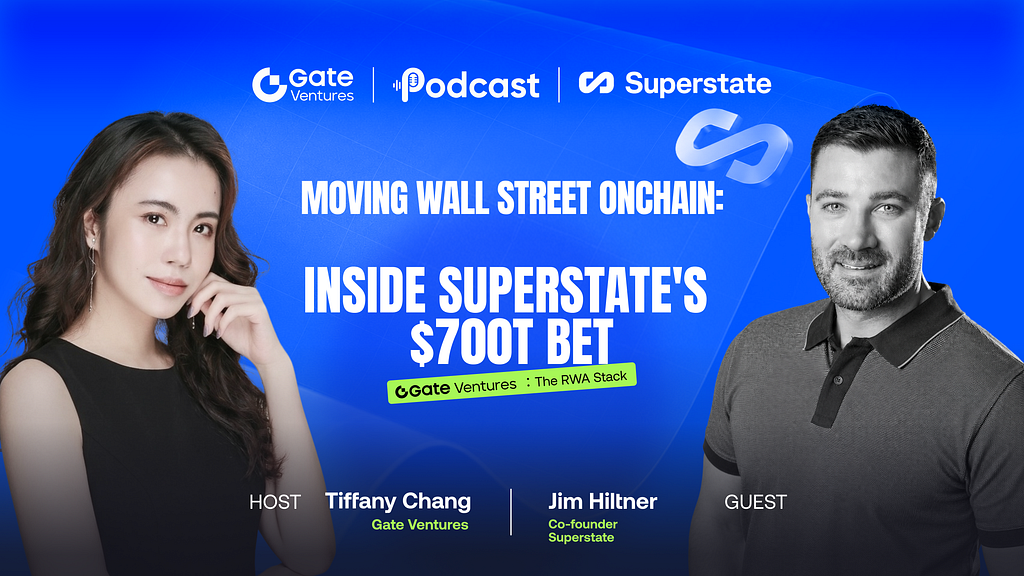
Gate Ventures Podcast EP.6
Guest: Jim Hiltner — Co-founder, Superstate
We recorded this episode hours after DTCC announced a trial run for tokenizing stocks. The timing was almost too convenient, but it made the framing obvious: the institution that sits at the bedrock of U.S. capital markets is now running the same experiment the crypto industry has been running for five years.
Meanwhile, the token market is in a drawdown nobody wants to say out loud. That gap — flat token prices, accelerating institutional build-out — is the whole story of this cycle, and it’s the gap our guest lives in.
Jim Hiltner started out in the back office of a bank, came up through traditional finance with a CFA, and made what was at the time a genuinely contrarian bet: leaving TradFi for Compound during DeFi summer. There he built Compound Treasury, the first DeFi business to earn a credit rating from S&P. He then left with Robert Leshner to co-found Superstate, which today runs a digital transfer agent, over $1.3 billion in platform AUM, and partnerships with Invesco, Galaxy, and Coinbase Asset Management.
What follows are the ideas from that conversation we think every builder, allocator, and issuer looking at RWAs should sit with.
1. Institutions want programmable finance. They don’t want DeFi.
We opened with an a16z piece arguing that institutions want blockchains but not DeFi. Jim agreed, and his reasoning cuts to the structural conflict:
“The whole concept of DeFi is getting rid of intermediaries. And it’s contrary to the business model of a lot of institutions, which are by definition intermediaries.”
An entirely permissionless environment is not a world a regulated institution can live in. But the rails — 24/7 markets, instant settlement, programmable interactions between counterparties — are exactly what they want.
His example is Aave Horizon: DeFi’s borrowing and lending technology, but where the underlying assets and the participants are KYC’d, identified, and legible to regulators. You get the mechanics of a permissionless protocol with the counterparties of a traditional market.
“The one-meter-high ceiling of the legacy world of crypto will never have escape velocity to reach the hundreds of trillions of dollars in traditional capital markets unless you build the right regulatory apparatus.”
That sentence is essentially Superstate’s founding thesis.
2. Stablecoins woke institutions up before the ETFs did
The consensus narrative dates institutional adoption to the Bitcoin ETF. Jim pushes the clock back further.
Back at Compound Treasury in 2021, the first question from every institution he pitched was never “what is Compound?” or “how is the yield generated?” It was:
“Okay, you’re taking my money, and then you’re turning it into a stablecoin. What is Circle? What is USDC?”
Five years later, that question is table stakes. Digital dollars are understood. Blockchains are understood. Smart contracts and protocols are now the next layer of the capital markets that everyone is working through.
The more important observation is about persistence. Prior cycles produced pilots and exploratory diligence that died when the market turned. This time, the institutional track detached from the price track — the momentum did not die when the bear market hit. Superstate is currently working through RFPs from some of the largest banks on the planet for 2026 launches.
His read on the U.S. policy sequence: the GENIUS Act unlocked stablecoin building; the CLARITY Act is the bigger unlock for institutional participation, and the catalyst he’s watching this year.
3. Three flavors of tokenization — and they are not competing
“RWA” has become a bucket that swallows very different structures. Jim breaks securities tokenization into three, with a heavy disclaimer up front: each has real use cases, they are not mutually exclusive, and none is categorically better. It depends on who you are.
Wrapped tokens. A custodian, SPV, or broker-dealer holds the underlying security on its balance sheet, entirely off-chain, with no relationship to the issuer. The token gives you price exposure.
“When Tiffany holds a wrapped Tesla stock on-chain, you’re getting exposure to the price performance of that Tesla stock, but you don’t actually sit on the cap table.”
The advantage is scale and reach — you can wrap hundreds of stocks without negotiating with a single issuer, and open access to markets that can’t reach U.S. equities directly. The cost is a counterparty standing between you and the asset.
The DTCC model. Jim calls DTCC the 8,000-pound gorilla — not 800. Think of the Wi-Fi symbol: DTCC is the bottom arc, with broker-dealers and clearing firms layered above. Their tokenization improves how those participants interact with each other — repo, settlement, collateral mobility. Real value, but you and I can’t touch it, because we don’t have an account at DTCC.
Native issuance. Superstate’s model, alongside Securitize, Figure, and others: working directly with the issuer so the token is the ownership record.
“When you actually hold a token issued through Superstate, you own a piece of the cap table. There’s nobody in between. There’s no broker-dealer. There’s no SPV. You literally own that stock.”
4. What native issuance actually buys you: control, and a two-way relationship
Two things fall out of collapsing the Wi-Fi symbol down to one ring.
For the holder, it restores the crypto ethos of self-custody to a real security — you can move it, use it, and interact with capital markets without asking permission.
For the issuer, it opens a surface area that simply doesn’t exist in traditional markets: they know exactly who their investors are, in real time. They can act on that. Jim’s example is deliberately mundane and therefore convincing — an issuer noticing you’ve held for six months and airdropping you something for it.
5. The legal machinery: a transfer agent that reads the blockchain
How does any of this stay compliant? The answer is a specific U.S. regulatory license.
Superstate runs a digital transfer agent — the entity legally responsible for recording ownership of a stock or fund. Investors onboard and KYC, then associate wallets (MetaMask, Phantom, Anchorage — Superstate is agnostic) with their off-chain identity. From there:
“The transfer agent license reads the blockchain so that we can keep track of ownership in real time. So if Tiffany moves her shares into Aave to borrow stablecoins, we track all of that activity and enable the issuer to be compliant.”
Traditional transfer agents do the same job with spreadsheets and humans. This is the same regulatory obligation, discharged by reading state that is already public.
6. Why an issuer tokenizes: five reasons, ranked
Galaxy — a $10 billion market cap company already listed on Nasdaq — did not need another venue. Jim’s breakdown of why issuers come anyway:
- Access. Anyone with an internet connection and a wallet can participate. The only gate is KYC, which is precisely why institutions are comfortable working with Superstate.
- Utility. Investors want to do more with their assets — post them as collateral, borrow stablecoins, loop, cross-margin — under their own control rather than a broker’s.
- Engagement and transparency. Under the Wi-Fi stack, the issuer sits at the top and genuinely does not know who its end investors are without requesting spreadsheets quarterly. On-chain, it’s a live view.
- Efficiency. Dividends, votes, and corporate actions currently feed a long chain of service providers. Programmable versions delete most of that cost, which makes raising capital cheaper.
- Stablecoin compatibility. Covered next, because it deserves its own section.
7. The Invesco lesson: distribution follows stablecoins
Jim’s analogy is e-commerce. Imagine a retailer in 2002 deciding not to build a website. That’s the decision an asset manager makes by not tokenizing.
“There’s $300 billion of stablecoins. There are going to be trillions. And if your job as an asset manager is to raise capital, that’s a large amount of assets you would not otherwise be able to tap into.”
This is why Stripe bought Bridge, why PayPal, Mastercard, and Visa are in stablecoins — payments moved on-chain, and the front-end experience didn’t have to change for the settlement layer to. The same shift is arriving in asset management. Invesco, running $2.3 trillion, now actively manages a fund Superstate created.
The corollary matters for exchanges too. Jim’s second customer cohort is large on-chain platforms with heavy volume that have realized the assets currently listed aren’t the ones building sustainable long-term businesses. Tokenization lets a platform hold the client relationship and grow wallet share, instead of watching that capital leave for a brokerage account elsewhere.
“The future is not 75 different logins. It’s all under one platform.”
8. On-chain IPOs are coming as a sleeve, not a replacement
Would a company ever IPO entirely on-chain? Jim’s inspiration is, of all things, Pump.fun: proof that enormous capital can be reached peer-to-peer, with no investment bank, through smart contracts and stablecoins. Swap the memecoin for a company with an SEC filing and you have the shape of the future.
But he’s a pragmatist about the timeline, and the bottleneck is liquidity, not issuance.
“If SpaceX IPO’d on-chain entirely, the liquidity of the secondary markets isn’t quite there yet for that stock to trade as much as it does on the Nasdaq today.”
Nasdaq turns over roughly $200 billion a day. Raising a billion on-chain is already possible; giving those investors somewhere to trade afterwards is not. Investors have 10-year horizons and 10-day horizons, and capital markets need both.
So Superstate is targeting two realistic first proof points:
- IPO carve-outs. Working with major investment banks to allocate a sleeve — 2%, 5%, 10%, to be determined — to on-chain investors. Critically, it’s an incremental bid, not a cannibalistic one: a billion-dollar raise might become $1.2 billion by reaching demand the bank can’t.
- The Direct Issuance Program. The on-chain analogue of an ATM (at-the-market) offering, the mechanism MicroStrategy, BitMine, and SharpLink use to raise equity at market prices off a shelf registration. Instead of instructing a broker, investors buy shares directly from the company. The first one launches soon.
9. Why there’s still no 24/7 venue — it’s regulation, not technology
If the infrastructure supports round-the-clock trading and settlement, why hasn’t anyone hosted live 24/7 markets for natively issued tokenized stocks? Jim is unambiguous: it’s a regulatory barrier.
Of the two DeFi market structures, only one is currently reachable. On the RFQ side, Superstate ran the first pilot with a real security — GLXY traded on Jupiter with Wintermute as market maker, roughly a million dollars of inventory. Proof of concept, not scale, but it worked.
AMMs — where the actual volume is — remain closed to U.S. securities. The SEC’s anticipated innovation exemption is the gate, and everyone is waiting on the final wording. Wrapped products sidestep this because they’re offered offshore and aren’t technically U.S. securities.
“The good news is that Superstate’s already built all the connectivity to the venues I just mentioned. As soon as that’s permitted, you’ll see a lot of activity day zero.”
10. The missing piece of composability: securities lending
Collateral works. Superstate assets sit in a dedicated market on Kamino (GLXY, FWDI, USCC, USTB), and were among the first assets in Aave Horizon, peaking at three to four hundred million. Morpho markets exist too. The collateral use case has been built and demonstrated to the SEC.
What doesn’t exist is the other half:
“The collateral in those venues is just sitting there idle. It’s not rehypothecated. You can’t lend out your Galaxy. You can borrow against it and park it as isolated collateral.”
That’s a deliberate and reasonable choice for now, but Jim thinks it’s the single biggest gap — and the analogy that lands hardest is the one every retail investor is unknowingly living inside:
“You hold your Apple stock at a broker, they might lend it out to a hedge fund borrowing at 60% APY. The broker’s not paying you any of that yield, but they’re lending your asset out. I want to participate in the economics — and I also want to control who the borrower is.”
Securities lending is a revenue line that can approach half the income of some brokers and clearing firms. His prediction is a repeat of the stablecoin migration: people moved idle cash on-chain because they could lend it out and earn eight percent instead of nothing. When holders of tokenized equities get the same optionality, they’ll look at $10,000 of idle Apple sitting at a broker and make the same move.
11. How a multi-trillion-dollar manager actually says yes
Superstate built USTB from a first ten-thousand-dollar check to over a billion. Rather than run it forever, they ran an RFP to find it a permanent home — and Invesco won it.
The instructive part is what made it work, because it’s the opposite of how crypto usually operates:
“Some folks and builders in crypto want to see quick wins. Certainly a deal like that was not a quick win. It was a long-term relationship.”
Invesco had a cold-start problem in tokenization and no desire to build the stack from scratch; Superstate had the stack and no distribution at that scale. Invesco had already gotten comfortable with digital assets through Galaxy on its Bitcoin, SOL, and ETH ETFs.
The second-order effect matters more than the deal itself. That diligence became a credential. Coinbase Asset Management’s CUSHY was Superstate’s first external fund, and Jim is direct that it wouldn’t have happened without the Invesco process behind it. The product has since been rebranded FundOS — a fund operating system for managers launching new funds or migrating existing ones on-chain. Invesco also invested in Superstate’s Series B.
12. Which intermediaries survive?
Asked whether smart contracts make traditional middlemen unnecessary, Jim was careful about naming names but blunt about direction: this is a board-level conversation at a lot of firms right now, and Superstate has already replaced some of those roles in the products it’s shipped.
He frames DTCC’s pilot as a tailwind rather than a threat — the incumbent’s reach brings attention and capital toward what’s actually possible.
The warning is for the firms doing nothing:
“Those that are completely ignoring this, that are short crypto or short DeFi or short smart contracts or short stablecoins — they will very likely find themselves in the next three to five years without a job.”
On what success looks like: Superstate sits at roughly $1.3 billion in platform AUM with around 300 institutional investors, and Jim would be surprised to end this year under five billion. He also expects the issuer mix to broaden past crypto-native names — AI companies and others chasing differentiated demand channels.
13. What retail actually gets out of this
Our closing question was the one that matters to most listeners: when stocks and funds are natively issued on-chain, what new opportunities open up?
Cross-collateralization and the super-app model come first — stocks, funds, ETFs, prediction markets, stablecoins, and memecoins sharing one balance sheet, with an interconnectedness Jim doesn’t think people have fully priced in. Then 24/7 markets. Then real-time dividends, replacing what he fairly calls wonky machinery:
“You can earn a dividend for eight seconds, versus having to hold it specifically at midnight on July 15th so you get today’s dividend, and then it goes ex-dividend tomorrow and drops by the amount.”
But the answer he keeps returning to is access. His example is Circle’s IPO, which traded up enormously in its first weeks precisely because so many people couldn’t get into the deal on day one. That gap between the investors who want a product and the investors permitted to buy it is, in his view, the real thing tokenization dissolves.
Closing: the asset side is finally catching up to the rails
A recurring theme across this conversation: crypto spent five years proving out infrastructure — instant settlement, composable collateral, permissionless access, peer-to-peer capital formation — on top of an asset base that couldn’t carry institutional weight. The rails arrived before the cargo.
What’s changing now is the cargo. Treasuries, funds, and equities are being issued natively into those rails, with the regulatory apparatus underneath them. And on the other side, an institution as central as DTCC is running tokenization pilots of its own.
The bear market in tokens and the build-out in capital markets infrastructure are, at this point, two unrelated stories. Only one of them is on a five-year clock.
Three questions to carry into any tokenized asset:
- What do I actually own? Price exposure through a wrapper, an entitlement inside a closed institutional network, or a position on the cap table? All three are legitimate. They are not the same instrument.
- What can I do with it once I hold it? Access without utility is just a different brokerage account. Collateral, lending, and cross-margin are where tokenization earns its premium.
- Where does the liquidity come from? Issuance is the easy half. Ask which venue you exit through, and under which regulatory permission it operates.
The full episode is now available on YouTube and Spotify.
🔹 YouTube: https://youtu.be/UXylSW77_HM?si=-MZXsJvgE2XrMkYf
🔹 Spotify: https://open.spotify.com/episode/50FtarDTMf9z6Xmsudwxpy?si=1luhtrKMSSymwShFzYIrFA
About Gate Ventures
Gate Ventures, the venture capital arm of Gate, is focused on investments in decentralized infrastructure, middleware, and applications that will reshape the world in the Web 3.0 age. Working with industry leaders across the globe, Gate Ventures helps promising teams and startups that possess the ideas and capabilities needed to redefine social and financial interactions.
Website | Twitter | Medium | LinkedIn
The content herein does not constitute any offer, solicitation, or recommendation. You should always seek independent professional advice before making any investment decisions. Please note that Gate Ventures may restrict or prohibit the use of all or a portion of the services from restricted locations. For more information, please read its applicable user agreement.
【免责声明】市场有风险,投资需谨慎。本文不构成投资建议,用户应考虑本文中的任何意见、观点或结论是否符合其特定状况。据此投资,责任自负。