
DeFi Warhol
 X
X
观点

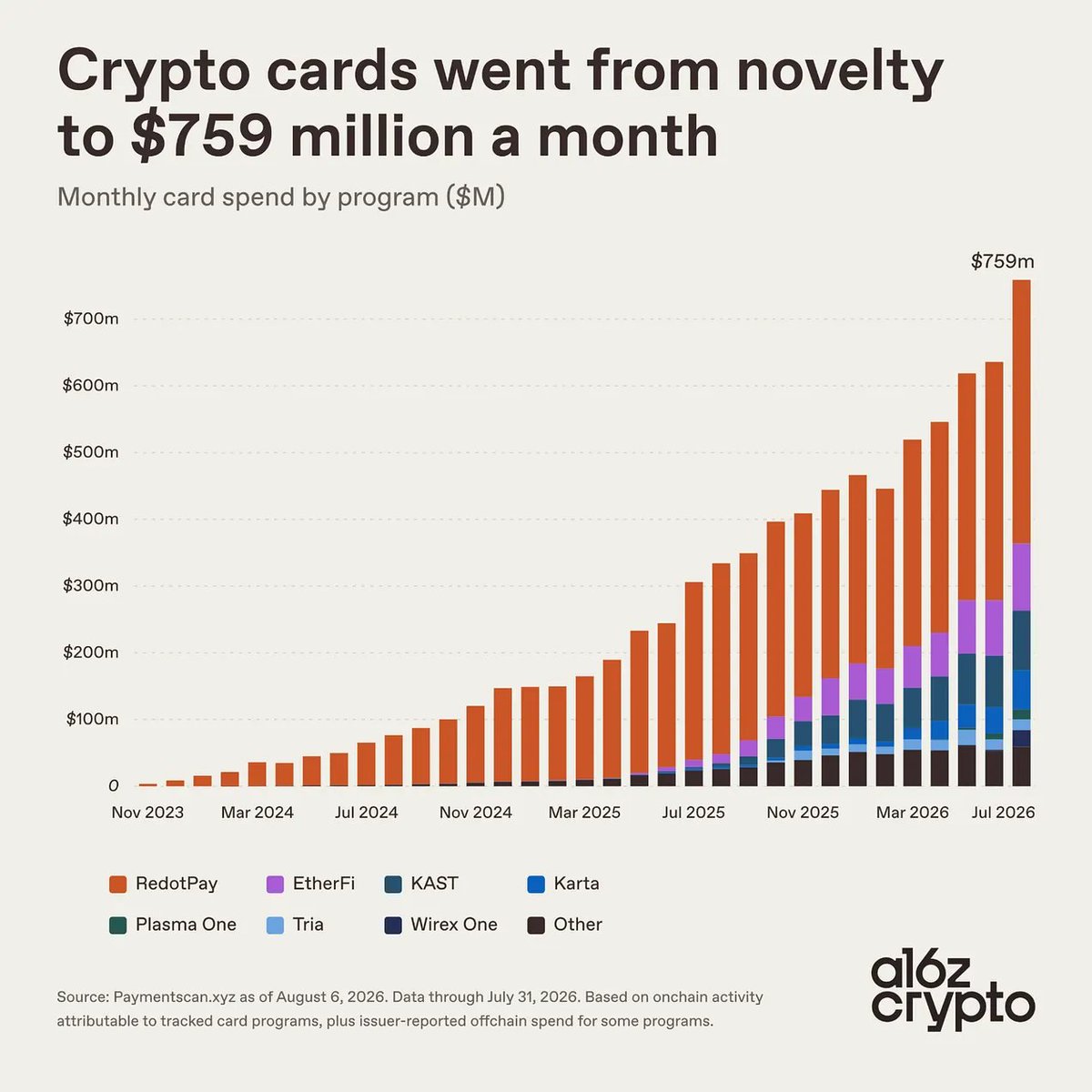
Crypto cards processed a record 9M purchases in July, roughly 2.5× the volume from one year earlier.
Here's what happened this week ↓
• @Paymentscan | July data showed RedotPay, KAST and http://ether.fi all posting double-digit monthly growth as stablecoin card usage kept climbing.
• @ether_fi | Summer release added tokenized stocks and metals, 30+ fiat rails, and portfolio-backed borrowing you can spend through the Cash card.
• @KASTxyz | KAST hit its second anniversary with a redesigned app and a 48-hour promo paying 20% back on food and dining, capped at $20.
• @BitgetWallet | Assetback now returns up to 3% of card spend in assets like Bitcoin, tokenized gold, and tokenized stocks.
• @useTria | Tria's August Summerfest doubled card cashback caps and Tria Points for the month. Campaign runs through August 31.
• @ustarpay | UstarPay officially launched its app and virtual card, letting eligible users deposit and spend USDT in everyday transactions.
• @get_revuto | Revuto opened access to its non-KYC Visa debit cards, usable at 150M+ merchant locations worldwide.
• @Plasma | Plasma One launched a limited campaign offering 10% back on eligible Starlink payments made with its stablecoin Visa card through August 15.
• @RedotPay | RedotPay ran a one-week promo cutting virtual Visa card cost by 40%, bringing issuance down to $6 for eligible new users.
• @GetCoinZoom | CoinZoom said average transactions per active cardholder roughly tripled, with users earning around $150/month in rewards during H1 2026.
• @coinbase | Eligible new U.S. Coinbase One Card users get $50 in BTC after completing $100 in purchases. Targeted offer runs through August 31.
• @cryptocom | http://Crypto.com added tokenized U.S. stocks and ETFs for EEA users, bringing another asset class into the app used to manage crypto and card balances.
• @Mastercard | Mastercard completed its acquisition of stablecoin infrastructure company BVNK, strengthening the rails behind future stablecoin payments, settlement and card products.

I went through @Delphi_Digital’s report on crypto neobanks, and there’s a lot in there.
Here are the bits that stood out to me ↓
1️⃣ Crypto card usage is growing fast
Crypto card volume hit $9.8B cumulative, with 23.43M transactions and 1.6M addresses.
May 2026 alone did $830M+ in monthly volume, roughly 16x growth in two years.
And even that likely undercounts the market because exchange-issued cards like @Coinbase and @Gemini settle some activity internally, so it does not show up onchain.
2️⃣ The market is already concentrated
There are 190+ crypto neobanks now, but most volume still goes through a small group of players.
This feels like one of those markets where everyone launches the same card, but only a few have a real edge.
3️⃣ @Visa is still the king here
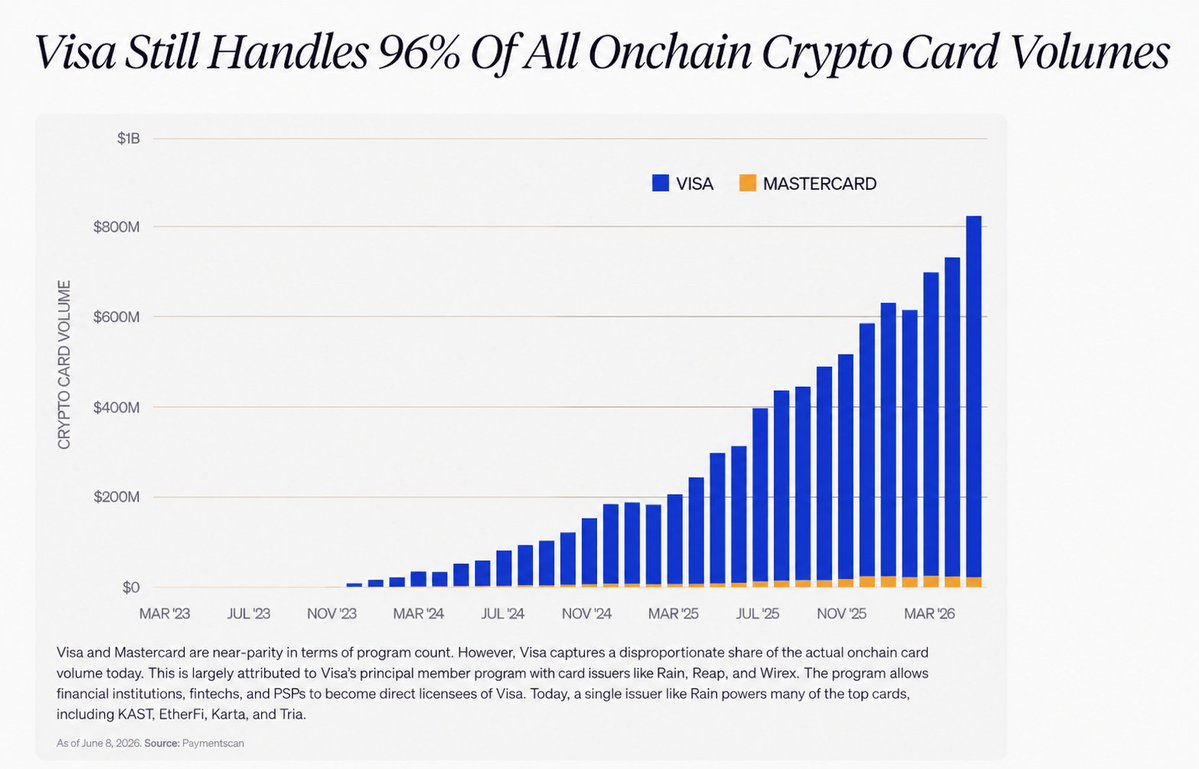
Visa handles roughly 96% of all onchain crypto card volume. Actually insane if I'm being honest.
And even when the front-end looks crypto-native, most of the experience still runs through existing card rails.
You tap the card, Apple Pay works, the merchant gets paid, and the crypto part mostly happens in the background.
4️⃣ The card is not the real upgrade
This was the most important part for me.
Because stablecoins make the payment stack more efficient behind the scenes.
Instead of relying on slow settlement cycles, companies get a faster way to move, reconcile, and manage money globally.
The user still gets a normal payment experience, but the backend gets cleaner.
5️⃣ Delphi splits crypto neobanks into 5 models
→ Full-stack issuers
→ Exchange-backed cards
→ Non-custodial DeFi-native cards
→ Stablecoin-native neobanks
→ Remittance-first cards
I liked this framework because it makes it easier to tell which teams are building a real financial product, and which ones are mostly shipping another card with crypto branding.
6️⃣ The picks-and-shovels model looks strong
Because full-stack issuers like @raincards sit closer to the card network layer, and they own more of the infra and capture economics across multiple card programs.
I like this model because full-stack issuers do not need to be the crypto card everyone uses. They benefit when more wallets, exchanges, and apps want to launch cards of their own.
7️⃣ The real demand is in weak banking markets
I don’t think the biggest use case is people in developed markets replacing Apple Pay or their normal credit card.
Those already work fine.
IMO, the stronger use case is in markets where traditional banking is expensive, unreliable, or hard to access, and that’s why @RedotPay stood out in the report to me.
8️⃣ Remittance-first cards feel more practical than “spend crypto” cards
For companies like @Bitso, @Felixpago, and @get_aspora, the card is more like the last step.
The real product is moving money across borders, giving people dollar access, and letting them spend locally after receiving funds.
Felix Pago has already processed over $5B in cumulative volume for more than 1M users across South America, which says a lot about where demand is real.
9️⃣ DeFi-native cards are trying to make the wallet the bank account
Products like @MetaMask, @phantom, @ether_fi, and @gnosispay are taking a different route.
Instead of moving funds from wallet → exchange → bank → card, the idea is to spend from the wallet side.
@ether_fi Cash is interesting here because users keep assets in an onchain vault and borrow against them for everyday spending.
Still early, but I like the direction.
🔟 The endgame is probably convergence
Stablecoins can win without every crypto company winning.
@Visa, @Mastercard, @Stripe, and other incumbents are already moving toward stablecoin settlement, so I don’t think this ends with crypto replacing the entire card stack overnight.
More likely, incumbents absorb parts of the backend upgrade, while a few crypto-native players survive by owning distribution, balances, or a very specific regional pain point.
My read:
A crypto card by itself is not that interesting anymore.
The winners will be the ones people trust to hold, move, and spend their stablecoin balances.

Finally, some hopium.
Here's some good things that happened in crypto this week ↓
1. $BTC finally gave the market a cleaner risk-on signal
We're back around the sub $80K level and briefly tested the $82K area which was the strongest level since late January.
Not saying everything is fixed, but after the last few weeks of going sideways, its nice to see a proper sign of life.
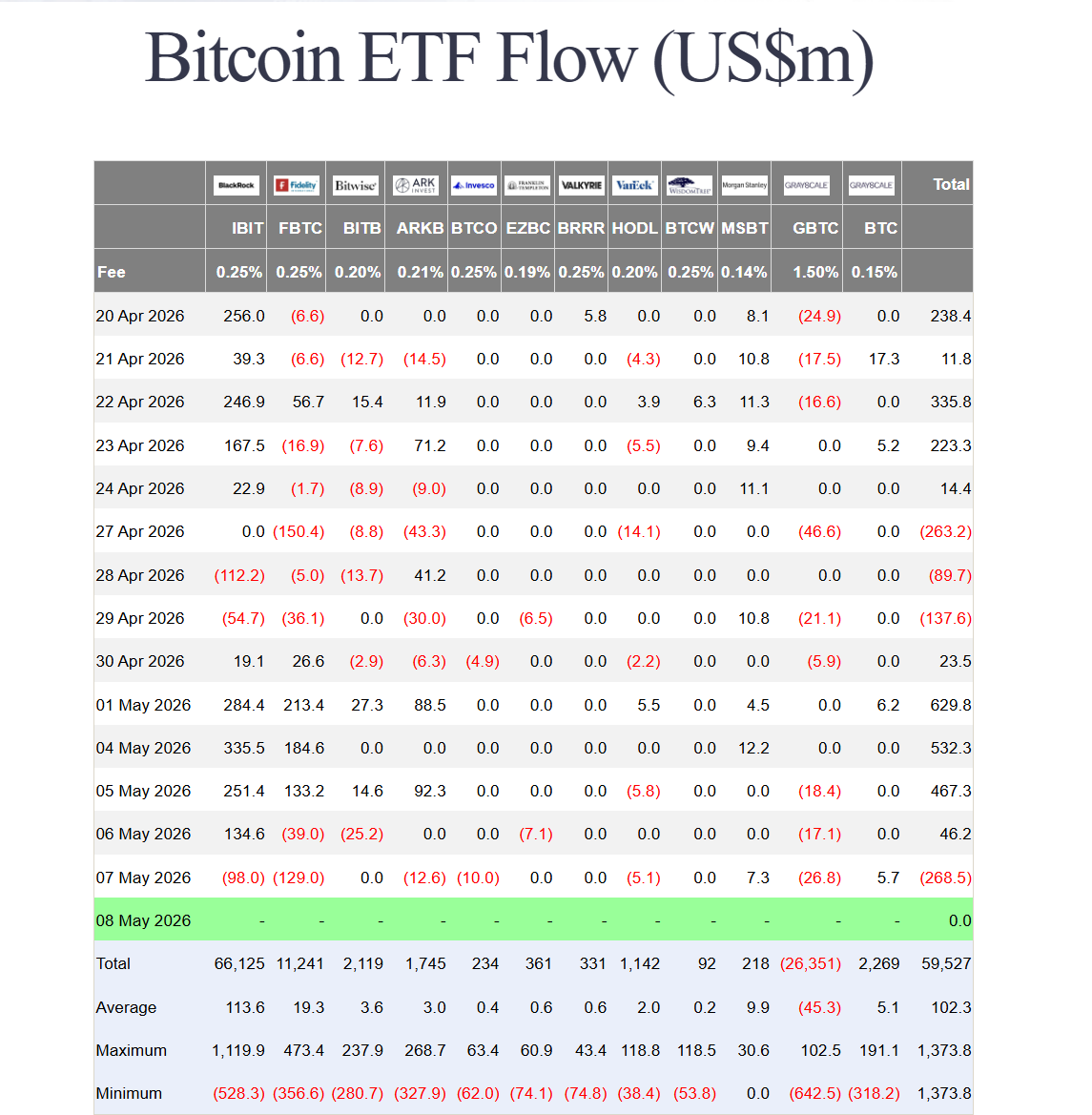
2. BTC ETF flows looked much better
@FarsideUK data showed strong inflow streak at the start of May:
→ May 1: +$629.8M
→ May 4: +$532.3M
→ May 5: +$467.3M
→ May 6: +$46.2M
May 7 flipped red with -$268.5M, so it's not a straight line up.
But overall, I think this is a much better picture than before.
3. Digital asset funds kept seeing inflows
@CoinSharesCo reported the 5th straight week of inflows into digital asset products.
Bitcoin led with $192.1M in inflows, bringing BTC YTD flows to $4.2B.
I like seeing institutional demand waking up.
4. VCs are writing big checks again
@a16zcrypto raised a new $2.2B fund focused on stablecoins, tokenization, perps, prediction markets, and AI agents.
@HaunVentures also raised $1B for crypto/blockchain investments.
Bigger players are still positioning.
5. The funding is going into real infra
@fun raised $72M for payments infra used by @Polymarket, @Lighter_xyz, and @Aave.
They process over $18B in annual volume, which makes this more interesting than another random "future of finance" pitch.
6. Stablecoin infra stayed hot
@opentrade_io raised $17M for stablecoin yield infra after passing $200M TVL.
Stablecoins still feel like one of the most obvious areas where crypto is finding real demand.
7. Tokenization got a big TradFi-style signal
@Bullish agreed to acquire @Equiniti for $4.2B.
Pretty big move toward tokenized equities and market infra.
8. Regulation also had a better week
@coinbase said there was progress on a key part of the CLARITY Act.
The market doesn't only need higher prices but also clearer rules, more institutional comfort, and products people actually use.
My verdict?
I'm not calling a total victory yet, but this week felt a lot less like doomposting szn.
Feelsgoodman.

Grayscale's Q2 watchlist reads like an institutional map of the next cycle's core infrastructure.
Financials tier is already settled.
Hyperliquid, Morpho, Pendle, Ethena are doing the actual volume and fees across perps, lending, and yield.
Smart contracts tier has the usual names (Celo, MegaETH, Monad, TON, Tron) plus two worth flagging.
Mantle has been the quiet outperformer, TVL surged 230%+ to $755M+ with strong stablecoin growth and active treasury deployment fueling real RWA traction like xStocks
Canton is the one CT keeps arguing about. DTCC, JPM, Visa, Circle all plugged in, but with 13 invited validators and removable history, purists don't think it counts as a blockchain.
AI tier is where it gets shaky.
Fabric, Flock, Grass, Nous make sense as early bets before the category sorts itself out.
Kaito and Venice are the weak picks. Kaito works only as long as CT keeps playing the attention game. Venice is a consumer AI wrapper, and wrappers die fastest in tech.
Utilities, DoubleZero, Jito, LayerZero, Wormhole, GEODNET, Helium, unsexy compounding layer. Used, not hyped.
What stands out is how heavily Grayscale is leaning toward protocols already generating revenue over the ones still selling a story.
Probably the right read of this cycle.

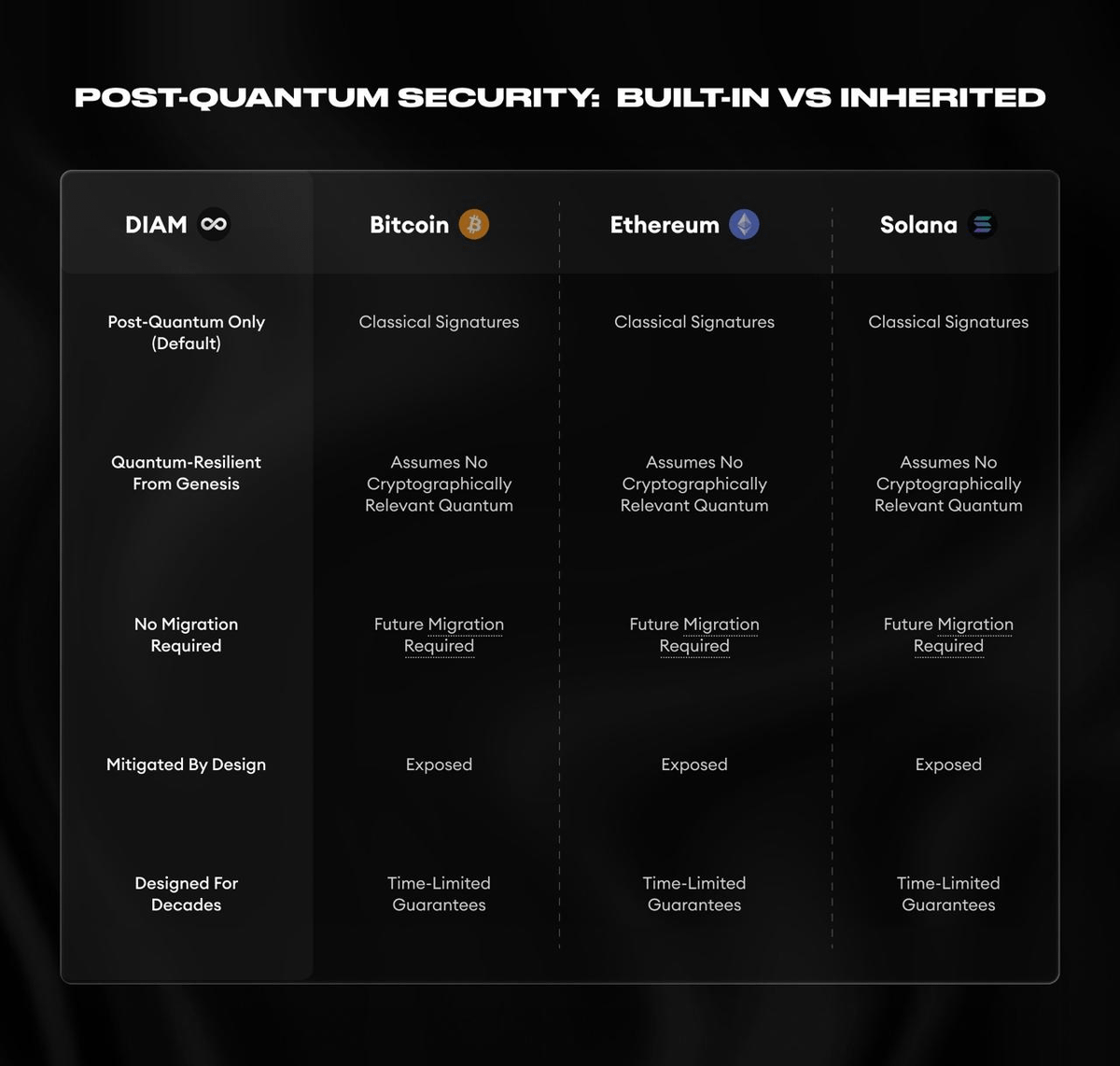
Quantum computing decryption isn't hypothetical.
As quantum computing advances, the data that was once encrypted will become readable. If infrastructure doesn't migrate on time, it risks exposing years of encryption history.
@diamante_io just launched mainnet as the first quantum-resistant L1, designed with quantum-resistant cryptography from the start.
Here's how they approach it:
→ Quantum-resistant encryption at genesis
→ Hybrid consensus for fast finality
→ EVM-compatible with native privacy
Most existing chains were designed before quantum resistance became a concern, so teams aim to patch this up after the risk becomes obvious, as it's viewed as a low-priority risk.
As a user myself, it's important that my data stays encrypted. Addressing it early can make the transition easier in the long run.
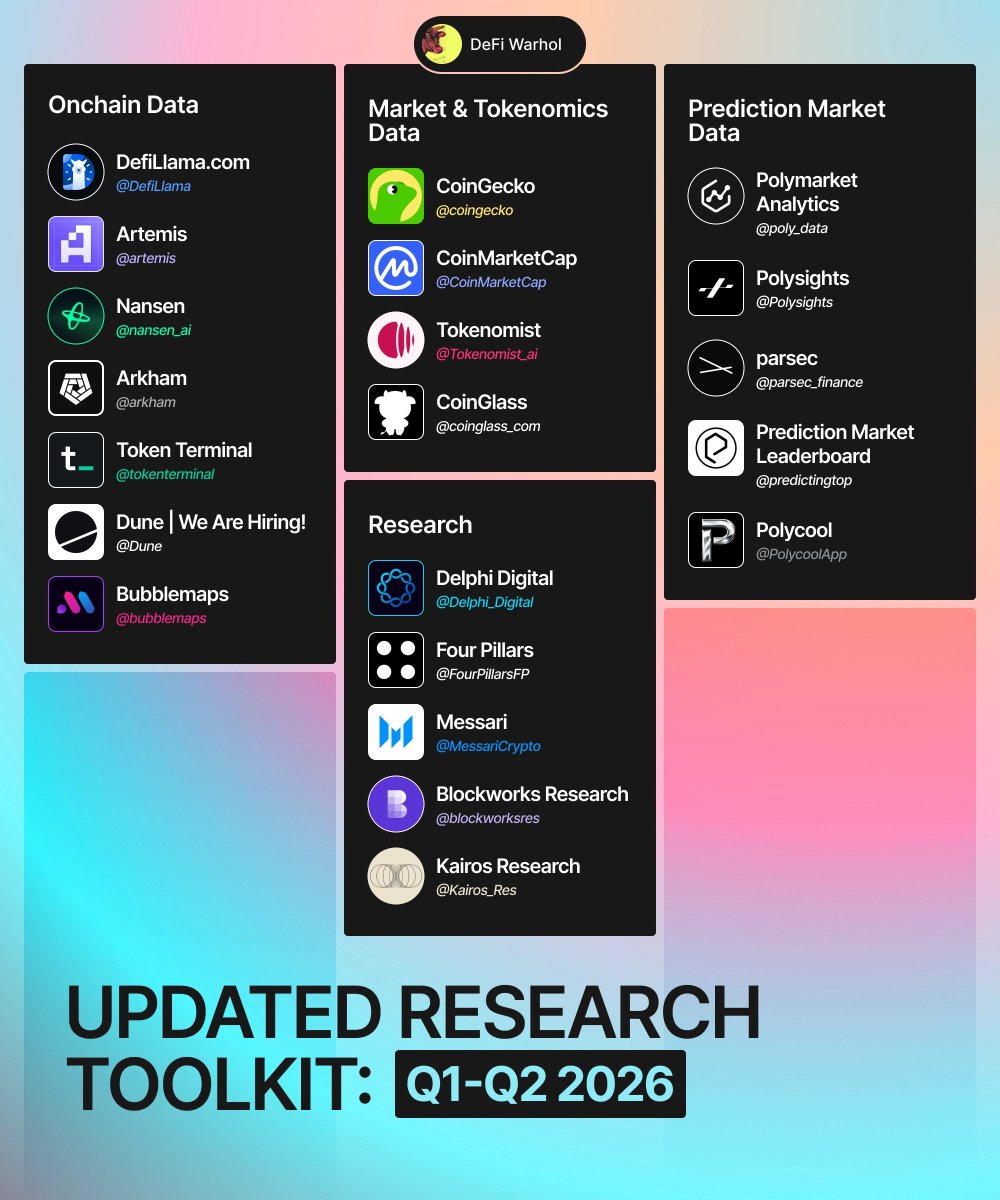
My Updated Research & Analytics Toolkit ↓
Onchain Data
- @DefiLlama: DeFi analytics for TVL, fees, revenue, and chain activity across crypto.
- @artemis: Fundamental analytics platform for onchain activity and real protocols usage.
- @nansen_ai: Smart money analytics platform tracking wallets and money flows.
- @arkham: Intelligence platform linking & tracking wallets to real-world entities.
- @tokenterminal: Fundamental data terminal for protocols and chains.
- @Dune: SQL-based analytics platform for building and sharing onchain dashboards.
- @bubblemaps: Visual tool mapping token holder clusters and wallet connections.
Market & Tokenomics Data
- @coingecko: Crypto price aggregator for tokens, exchanges, and market metrics.
- @CoinMarketCap: Market data platform tracking crypto prices, rankings, and token stats.
- @Tokenomist_ai: Tokenomics analytics platform tracking token unlocks and emissions.
- @coinglass_com: Derivatives analytics platform tracking futures volume, OI, liquidations, etc.
Prediction Market Data
@poly_data: Analytics dashboard for tracking Polymarket market activity and performance.
@Polysights: Data platform analyzing traders across Polymarket markets.
@parsec_finance: Real-time crypto analytics terminal for market and onchain data.
@predictingtop: Analytics account across prediction markets.
@PolycoolApp: Tool surfacing trending markets and insights on Polymarket.
Fundamental Research
@Delphi_Digital: Crypto research firm & VC with deep industry reports.
@FourPillarsFP: Asia-focused crypto research firm for markets and protocols.
@MessariCrypto: Institutional crypto research and data platform.
@blockworksres: Institutional-grade crypto research from Blockworks.
@Kairos_Res: Independent research firm for crypto narratives & trends.
Did I miss anything?
Hope you enjoyed this post and found some new VALUABLE information.
If you wanna support me, I'd appreciate a like, reply, and RT <3
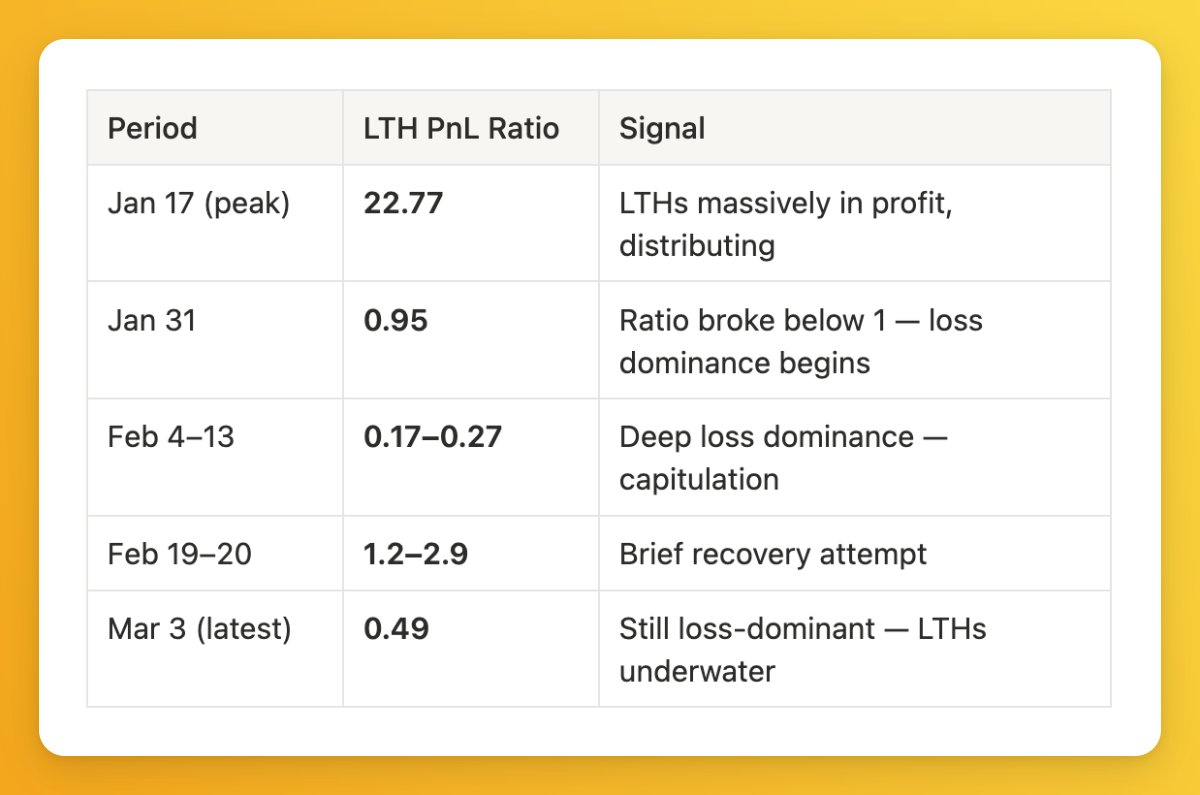
Long term holders are getting rekt.
$BTC that hasn’t moved much in ~155+ days.
When these holders start selling at a loss, it’s usually not a quick dip.
It’s real pressure in the market.
The LTH (Long Term Holder) PnL Ratio has been below 1 since late Jan, which means long term holders are selling more at a loss than in profit. Crazy.
In a normal dip, this ratio usually stays above 1 because strong hands are still selling in profit.
→ Jan 17 was peak profit-taking
→ Early Feb was heavy loss-selling
→ In March its still below 1, so the pressure isn’t gone
This market can’t hold upside for long. Hopefully this changes.
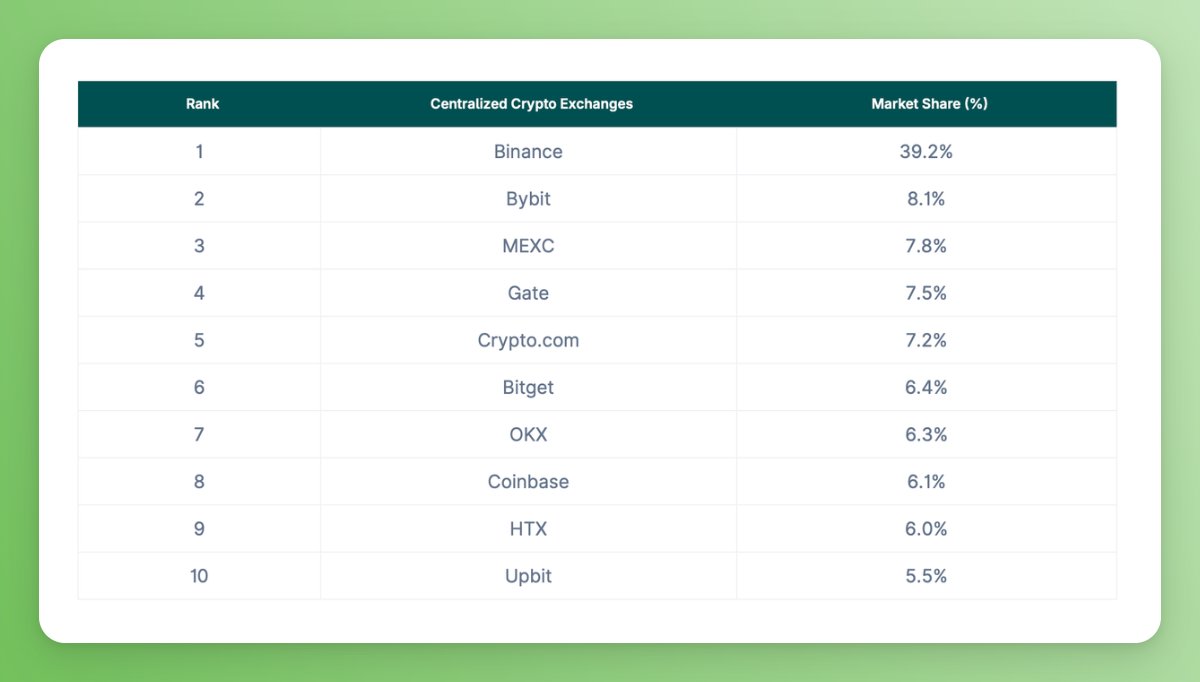
Most people think @coinbase is top-2 or top-3 by volume.
It's actually #8.
Here are the 2025 CEX industry leaders:
- @binance - 39.2%
- @Bybit_Official - 8.1%
- @MEXC_Official - 7.8%
- @coinbase - 6.1%
Binance kept its dominance with 39.2% market share, despite the -0.5% drop in volume from 2024.
MEXC was the fastest-growing exchange in 2025, with a +90.9% increase from 2024 – this is mainly due to their zero-fee policy that attracts traders and retail users.
Bybit slowly recovered its dominance since the 2025 February hack to finish #2 with $1.5 trillion in annual volume. Their market share fell to 8.1% in March, but climbed back steadily through year-end.
Most exchanges (6 out of 10) grew volume in 2025, pushing the combined top 10 volume up 7.8% from 2024.
Felt the need to share this, as Coinbase's brand perception doesn't match its actual market position