
Lorenzo Valente I @Consensus May 4-8
 X
X
观点

Who is actually accruing the value created in crypto?
This started as a conversation on the @Blockworks TG group with @santiagoroel and a few others.
Venture in crypto has shrunk a lot! and imo the main reason is that on-chain revenue pools have been far smaller than anticipated.
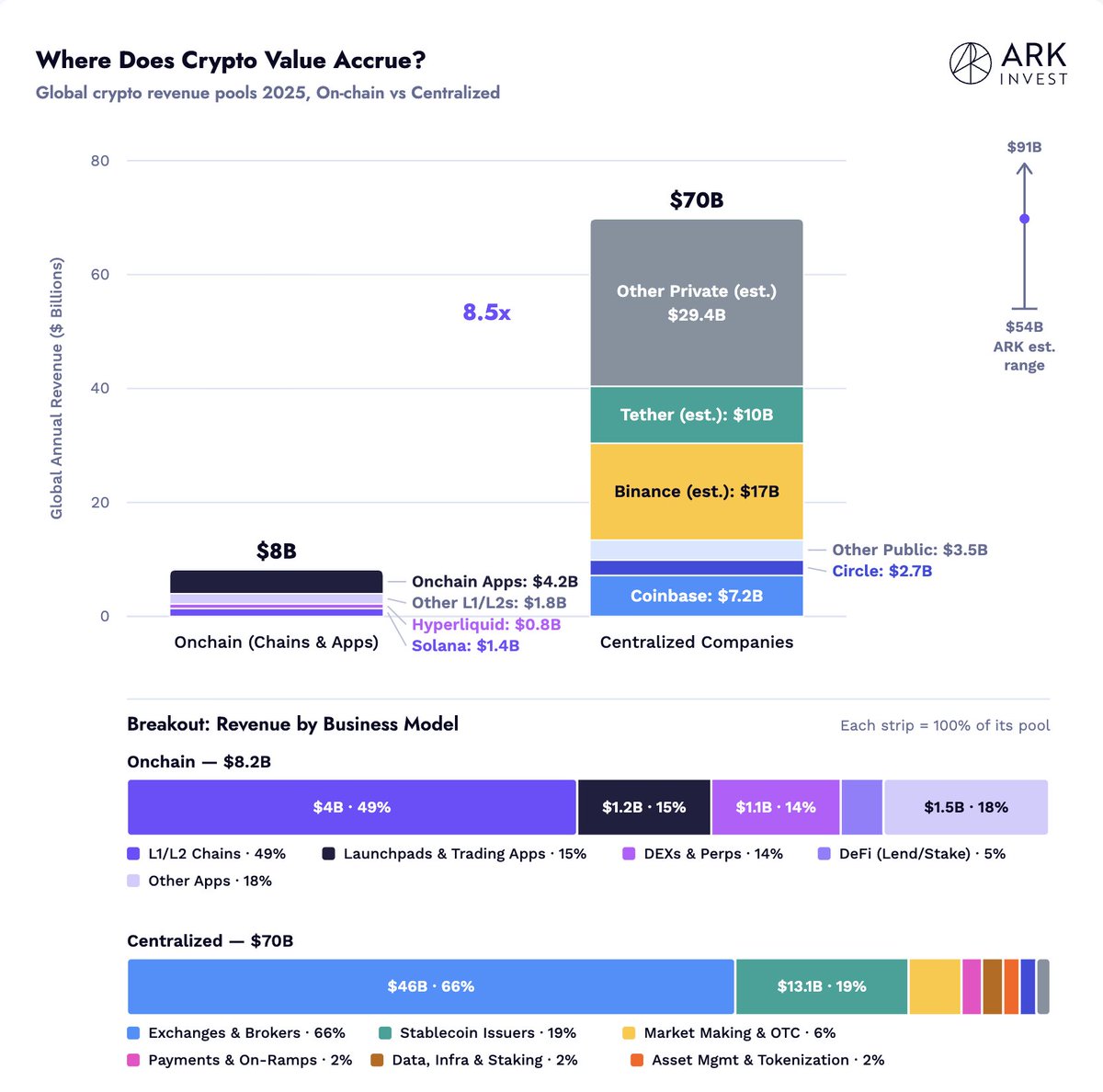
From Blockworks data, total on-chain revenue was roughly $8B in 2025, so I wanted to see how much off-chain/Centralized companies are capturing from this industry by comparison.
So consider the off-chain pool: public companies like coinbase, Gemini, BitGo, Bullish, plus crypto revenue from Robinhood, Galaxy etc and private players like Binance, Tether, FalconX, Anchorage, etc.
The result surprised me: off-chain companies generate ~$70B roughly, consider roughly a range between 60B to 100B, 8.5x more than on-chain protocols and L1s.
To put that $8B in perspective: even if you give on-chain protocols generous 70% EBITDA margins and a 30x multiple, the entire addressable market cap today is ~$168B ($8B × 70% = $5.6B EBITDA × 30x). That's the whole on-chain pie, less than a single mega-cap tech company.
Do the same for centralized companies at a more realistic 40% EBITDA margin: $70B × 40% = $28B EBITDA × 30x = ~$840B of justified market cap. Even with lower margins, that's 5x the entire on-chain ecosystem. And to put even that in perspective: the entire centralized crypto industry, all of it combined, is basically worth one OpenAI or Anthropic.
The breakdowns are telling too. On-chain, L1/L2 chains take almost half the pool (~49%), with launchpads/trading apps and DEXs/perps splitting most of the rest. Off-chain, it's exchanges and brokers dominating at ~66%, with stablecoin issuers second at ~19%, everything else (market making, payments, infra, asset mgmt) is single digits. Both worlds are extremely concentrated at the top of the same funnel: trading and the rails to do it.
From a venture perspective, you were often better off investing early in L1s and traditional exchanges than in most tokens. It was a bit simpler than we thought.
To me the common denominator: off-chain companies sit much closer to the end user than protocols and L1s. They own that relationship and monetize it well. They abstract away crypto's complexity: trade, stake, store, manage without ever touching a coldcard or metamask app and people pay up BIG for that.
On-chain is clearly in a bear market, but the lesson for protocols, L1s, and on-chain primitives is to build and verticalize more. Get closer to the end user.
One caveat: this is an approximation, done with Claude's help. Many of these companies don't have public earnings, so the private side (Binance, Tether, and especially "other private") is mostly an educated guess. Directionally though, the gap is hard to argue with.

On @Visa earnings call, the company was asked whether OpenUSD would compete with @circle , @tether, and the established stablecoin players.
Visa’s response:
“Visa, going forward, will remain multi-coin, multi-chain. Our role is not to pick winners. Our role is to help clients connect to the stablecoin ecosystem securely and at scale, regardless of which stablecoin, network, or infrastructure ultimately gains adoption.”
It is becoming increasingly clear that the commitment from OUSD’s partners is closer to a soft LOI than a strategic bet.
Of course they will support it. But supporting OUSD is very different from committing meaningful resources, distribution, or balance sheet to making it win.
I think this is the first time we’ve seen such a massive divide within DeFi teams from an investor’s perspective.
There are now clearly two different breeds of DeFi founders.
The first are the pre-DeFi summer protocols:
Many carry years of baggage: messy equity + token structures, tokens down 80-95%, frustrated communities, investors still looking for liquidity, and organizations built around a playbook that optimized for liquidity mining, crypto-native users, and early-adopter UX.
The second are teams that raised over the last few years:
They looked at all of that and decided they wanted none of it. They’re building for a completely different customer. They know crypto degens are simply too small a market to matter if the goal is to build a massive financial business. Many are even delaying token launches altogether while they figure out whether a token is needed at all, or whether the right long-term structure is equity, a token, or some combination of the two.
That changes almost everything:
who the ideal CEO is,
how you hire technical talent,
your go-to-market,
your fundraising,
your cap table,
and even how you think about tokens and equity.
I’m not saying the pre-DeFi summer teams are bad investments, we’re bullish on many of them.
But I do think the skills required to win in this next phase are fundamentally different. Some teams will successfully reinvent themselves. Others won’t. And I think that’s one of the biggest differentiators investors need to underwrite today.
We are entering a new era for DeFi.
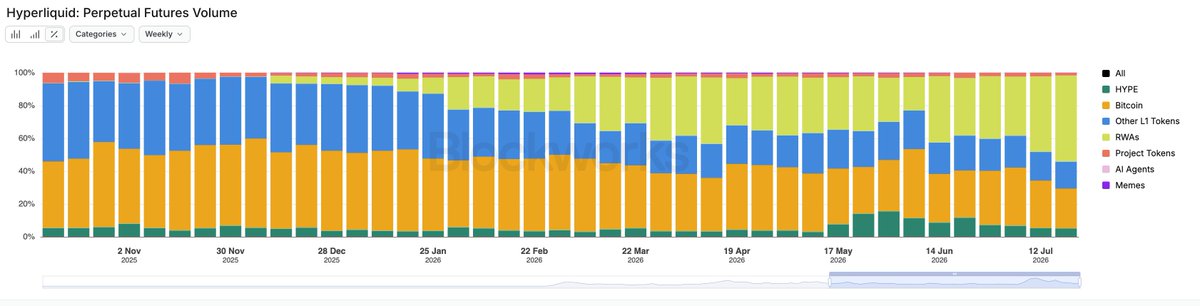
For the first time ever, @HyperliquidX generated more volume from RWAs than crypto in a single week. RWAs accounted for 54% of total trading volume.
An even more interesting trend: since June, single stocks have overtaken indices and commodities on HIP-3. Today, 61% of all RWA trading volume is in individual equities.
I’m no longer convinced RWA trading will naturally aggregate on the same venue as crypto. There will likely be category leaders within RWA, and owning BTC/ETH/SOL flow may become far less important than many people assume.
To put this into perspective:
Total DEX perpetual volume last week: $79B
Hyperliquid: $50B
Of that, $26B was HIP-3 RWA trading
In other words, Hyperliquid’s RWA market alone was larger than the combined crypto perpetual volume of every other DEX.
If you’re still only focused on crypto token trading, I think you’re focusing on the wrong market.
data from @Blockworks

On the Ethereum funding problem:
the ethereum funding debate is getting spicy and the best counter i've seen argues the real problem isn't funding, it's conviction. The linux kernel analogy: nobody pays kernel devs, yet they never lack contributors, because contributing to linux is so obviously valuable it converts directly into career capital. same with early ethereum, people built for free in 2016-2018 because the perceived value of participation made compensation irrelevant.
I think this argument has a lot of holes:
the linux comparison falls apart when you look at who actually maintains the kernel: red hat, google, intel, microsoft, all paying engineers full-time because it serves their commercial interests. ethereum client teams don't have that backstop. the "conviction converts to career capital" argument works great for devs shipping dapps. it does not work for consensus engineers doing maintenance on nimbus or teku that literally nobody outside the protocol layer will ever see on a resume.
the 2016-2018 nostalgia is also doing a lot of heavy lifting here. that era had a massive ICO bubble pumping perceived upside, ETH going from $10 to $1,400, and a much simpler codebase. you could contribute meaningfully in your spare time. today's ethereum needs deep specialization in distributed systems, cryptography, and formal verification. that's not getting done nights and weekends by passionate volunteers.
and the causality runs both ways. declining conviction causes underfunding, sure. but underfunding also causes declining conviction. when core dev slows, upgrades take longer, the protocol feels stagnant, and conviction drops with it. you don't let the plumbing rot while you sort out your narrative.
these protocols are far from their end state and what worked in the early days probably doesn't work now. ethereum has changed enormously, the complexity, the stakes, the competition. i don't think there's a clean answer here, but finding a more sustainable way to fund the ecosystem isn't optional. it's overdue.
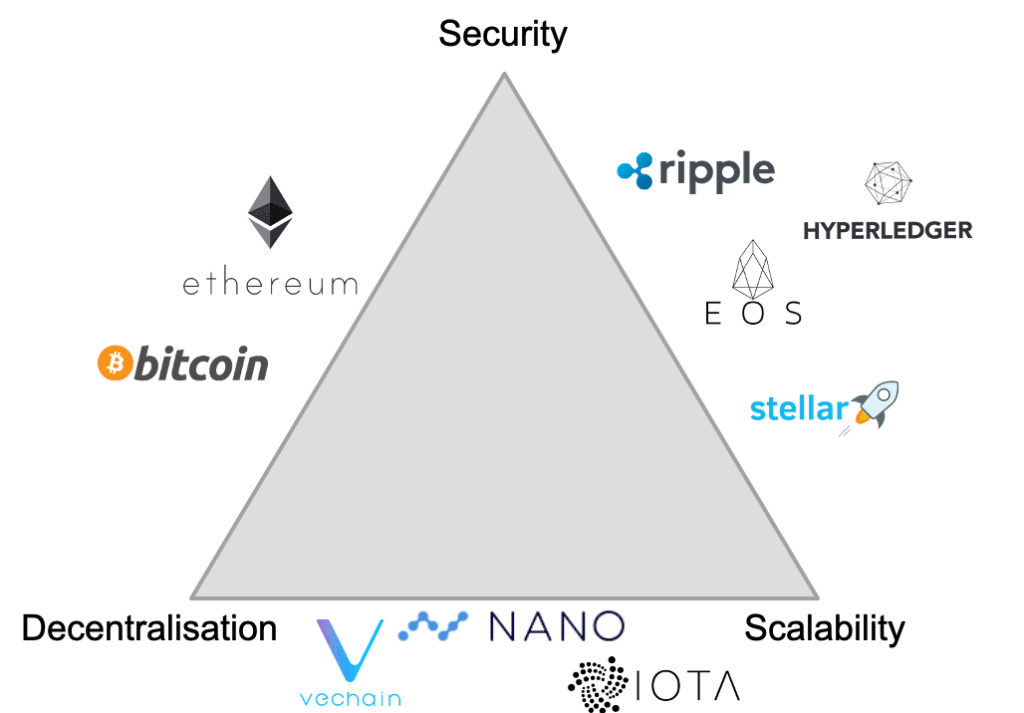
We've been thinking about the blockchain trilemma wrong for years.
The "Security" corner was never really about hacks, it was about conensus mechanism security (PoW/PoS attacks). But in practice, billions have been lost not to 51% attacks, but to smart contract exploits, bridge hacks, and protocol vulnerabilities.
The real trilemma institutions care about isn't theoretical consensus theory. It's:
→ Can my assets get drained by a buggy contract?
→ What are my actual risk exposures and how are they mitigated?
→ Is my counterparty's identity verifiable?
We've been optimizing for the wrong definition of security while the actual attack surface kept expanding.
The next generation of chains won't win by solving Nakamoto's trilemma. They'll win by solving the one that actually costs people money.