



Crypto Neobanks in 2026: Balance Sheet, Battleground, and the Yield Catalyst

Executive Summary
A neobank is a digital-first financial provider that makes an account — the place where a customer stores money, receives salary or business revenue, pays, exchanges currencies and manages finances — the centre of the relationship. The term describes a product and distribution model, not a single legal licence. Some neobanks hold full banking charters; others operate through electronic-money or payment licences, limited-purpose banking charters, or sponsor-bank partnerships. A crypto neobank adds stablecoin or digital-asset rails to that account layer.
For this report, a crypto neobank must offer a persistent customer balance plus several recurring account functions, such as a named account or IBAN, card spending, inbound and outbound bank transfers, foreign exchange, savings or treasury tools, credit, or business controls and APIs.
The theme of crypto neobank advanced significantly between mid-2025 and mid-2026. More than half a dozen of these apps launched over the past year, and funding has followed: KAST raised $80M at a $600M valuation and claims over 1 million users across 190+ countries; Rain, the card-issuing backbone underneath a large share of the category, raised $250M at a $1.95B valuation in January 2026; Slash raised $100M at $1.4B; Fasset raised $51M against $32B in annualised volume. Per McKinsey’s Global Banking Annual Review, banks’ revenues after risk cost reached a record $5.5T in 2024 and sector net income rose to $1.3T in 2025. The more instructive comparison for this category is the split within that pool: the world’s 1,000 largest banks generated $3.8T in revenues against $625B for the 1,000 largest fintechs, but fintech revenues grew 22% annually from 2021 to 2025 against 5% for banks, lifting the fintech share of their combined revenue from 10% to 17%.
Convergence is now running in both directions. Revolut filed for a US national bank charter in March 2026 with stablecoins named as a day-one product, while Nubank and Crypto.com both secured conditional OCC approval. These are part of a broader rush: McKinsey counts 21 US banking licence applications filed in 2025, against one in 2024 and five in 2023, with roughly 38% accepted and approval times about 40% faster than usual. Coinbase, meanwhile, has effectively published a neobank roadmap of its own — direct deposits, high-yield savings, USDC lending rates, account-to-account payments, an AI financial advisor, and collateralised borrowing against BTC and ETH. The differentiator is therefore no longer the crypto. Almost every traditional neobank is doubling down on crypto exposure, and almost every crypto-native firm is assembling a banking product surface. The remaining divergence is not a clean crypto-versus-fiat split but a ladder of balance-sheet permissions. Some platforms hold insured deposits and lend; Wyoming SPDIs accept fully reserved deposits but do not lend customer funds; trust banks such as Circle National Trust focus on custody and reserve infrastructure; and e-money or FinTech-licensed apps safeguard customer funds without a general lending franchise.
In this report we examine the scale of the category in numbers, what structurally differs from a traditional neobank, the key regulatory catalyst that will determine the sector’s economics over the next twelve months, and three structural advantages we believe are durable.
Crypto Neobanks in Numbers
Total stablecoin market capitalisation sits at approximately $313–316B as of mid-2026, up roughly 23% year on year. Supply nonetheless contracted by around $10B from May 2026 — the first such contraction in four years — while June transfer volume hit a record. Velocity, rather than float, is now the meaningful series. On adjusted data, H1 2026 volume reached roughly $8.82T, tracking toward approximately $17.6T for the full year against $10.8T in 2025. For a business model that monetises flow through interchange, FX and payment fees, rising velocity is a positive indicator for stablecoin-driven banking, a positive catalyst for crypto neobanks.
The payments denominator is nevertheless much smaller than the headline. McKinsey and Artemis estimate that only about 1% of 2025 stablecoin movement was identifiable real-world payments — roughly $390B, of which approximately $226B was B2B, around $90B payroll and remittances, and $8B capital-markets settlement. That is the pool crypto neobanks actually compete over today. This market is roughly thirty times larger than it was just two years ago, signaling an era of rapid adoption; with adjusted annual volume tracking toward a robust $17.6T, the sector now possesses a strong foundation for future growth.
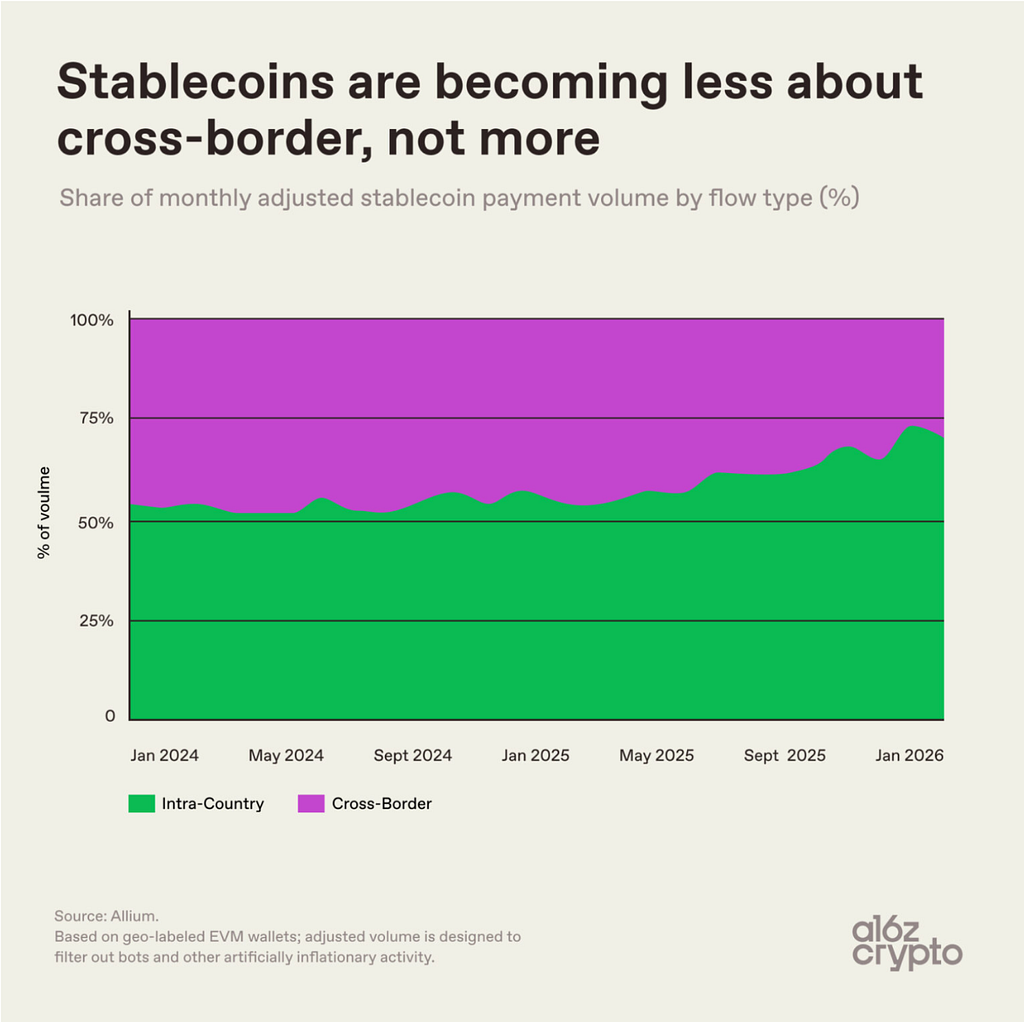
The cross-border framing is also weakening. Per a16z’s early-2026 data, intra-country transactions grew from roughly half of stablecoin payment volume in early 2024 to nearly three-quarters by early 2026. The main driver today is local stablecoin usage rather than remittance: users in Argentina, Turkey and Nigeria want dollar balance, local stablecoins for daily payment and P2P transfers. The trend is moving toward savings, spending behaviour and payroll capture in consumer habits where stablecoin adoption is already high.
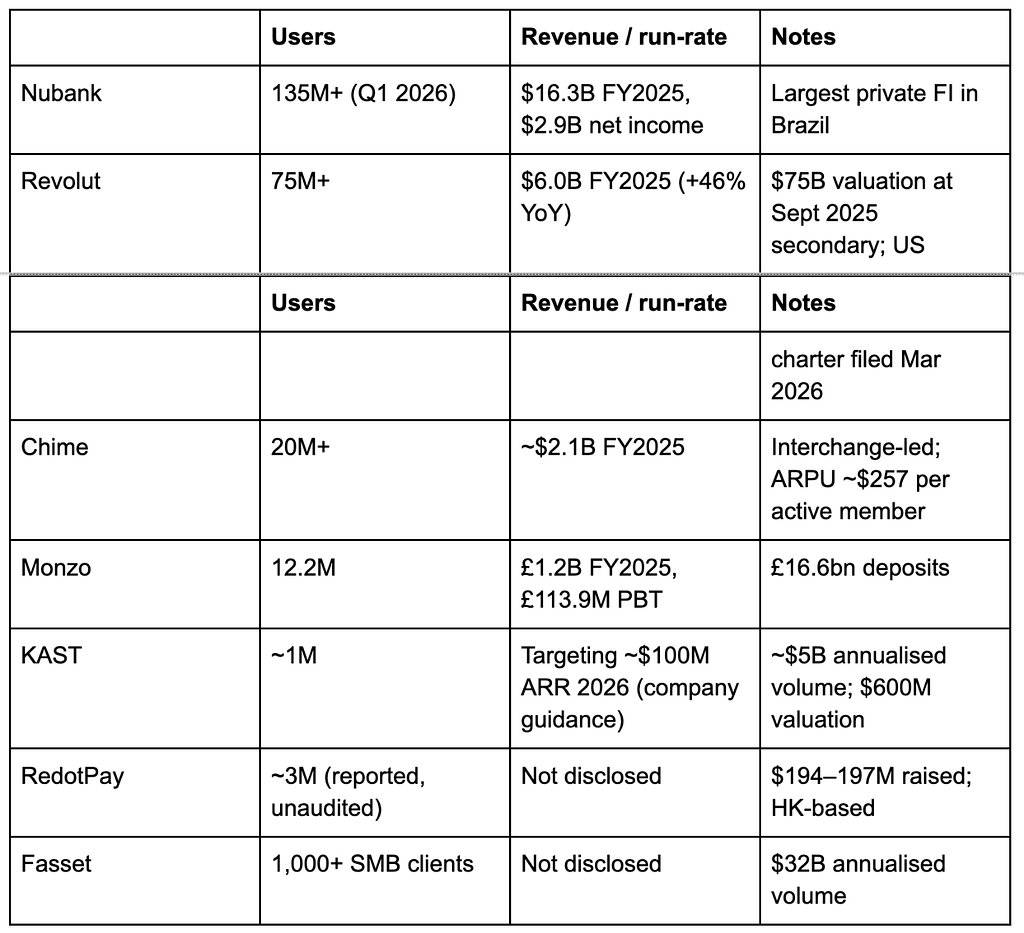
The revenue gap between the two cohorts is three orders of magnitude, and no thesis claiming crypto neobanks currently outperform traditional neobanks survives that comparison. The defensible claim is narrower: they are compounding faster off a small base in segments where the incumbent model is structurally disadvantaged. Two figures in the table above are worth a second look. KAST’s guidance of roughly $100M ARR against approximately $5B in annualised volume implies a blended take rate near 2%, which is roughly double what card interchange alone yields in most markets and well above EEA interchange caps — meaning the guidance embeds substantial subscription and FX contribution rather than card economics. Fasset’s $32B across more than 1,000 clients implies roughly $32M of annual throughput per client, the clearest quantitative evidence in the category that corporate flows are where volume already sits.
Business Models
The category is best read as a spectrum rather than a single business model. The decisive questions are who legally holds the customer’s money, what claim the customer receives, and whether the provider can deploy that balance into lending. The examples below separate the principal archetypes.
Deposit-and-credit neobanks: Nubank and Revolut
A full-service digital bank uses a current or savings account as the primary relationship, then layers cards, transfers, foreign exchange, subscriptions, investments, insurance and credit onto that account. Where Nubank or a Revolut banking entity operates under a banking licence, it can accept deposits and build a loan book subject to local capital, liquidity and conduct rules.
Fully reserved neobank: N3XT
N3XT is a Wyoming-chartered Special Purpose Depository Institution focused on business-to-business dollar settlement. It accepts deposits, keeps them at least 100% backed by cash or short-term US Treasuries, and does not lend customer deposits. Its product combines business accounts, verified counterparties, 24/7 programmable USD payments, APIs, custody-related capabilities and connectivity between traditional finance and digital assets. It is called a bank because the charter permits deposit-taking and banking activities such as custody and settlement; it is not simply transmitting money on behalf of another bank.
Trust-bank and stablecoin infrastructure: Circle
Circle is the clearest example of a banking model without a lending franchise, although the legal perimeter must be stated precisely. The group issues USDC and EURC through regulated affiliates and provides institutional minting and redemption, wallets and developer infrastructure, and the Circle Payments Network. In July 2026, Circle received final OCC approval to establish Circle National Trust, a national trust bank initially focused on fiduciary digital-asset custody, with management of USDC reserves planned as a future capability. It is a bank-regulated custody and reserve institution, not a retail checking bank, and it does not build economics around consumer loans. Circle’s 2025 Form 10-K shows the result: reserve income represented 96% of total revenue, while payments, integration and other services remained a smaller but growing line.
Swiss FinTech-licensed account: Fiat24
Fiat24 sits between a payments app and a full bank. Under a FINMA licence pursuant to Article 1b of the Swiss Banking Act, it offers individual and business customers a multi-currency cash account, Swiss IBAN, Mastercard debit card, peer-to-peer transfers, foreign exchange, bank-wire deposits and withdrawals, crypto top-ups, and API access. Its NFT-based account credential connects a verified customer identity to an Arbitrum wallet, giving third-party Web3 applications an account layer rather than only a checkout rail. The licence can permit public deposits or crypto assets up to CHF100M, but those funds may not be invested and interest may not be paid; Fiat24 also states that Swiss deposit insurance does not apply. It is therefore bank-like in the customer’s daily workflow but not a full-service bank.
Payment-led crypto neobanks: KAST, RedotPay and Fasset
These companies can still qualify as neobanks in the commercial sense when they provide a persistent balance, card, bank-transfer access, foreign exchange and treasury or payroll functions that customers use as an operating account. Legally, however, their services may be split across VASP, e-money, payment and card-issuer partners rather than one general banking charter. Their core monetisation is consequently interchange, foreign-exchange spread, subscriptions, reserve-sharing or transaction fees. A platform that only acquires merchants, processes a transfer or issues a card is a payment provider; it becomes a neobank only when it owns the broader account relationship.
These archetypes should not be valued as interchangeable peers. Nubank and Revolut benchmark the economics of insured deposits and credit; N3XT and Circle show two different non-lending bank models; Fiat24 demonstrates a limited account-taking licence; and KAST, RedotPay and Fasset represent the distribution and payment layer.
What Actually Differs From a Traditional Neobank
A traditional neobank’s business is the deposit. Whether the firm holds its own licence or rents one from a sponsor bank, the revenue chain is consistent: acquire the customer cheaply, capture the primary relationship, monetise through interchange, then net interest margin, and finally — at the step that generates most of the profit — lending against the deposit base. The pattern across the profitable cohort is uniform, with revenue per customer sitting well below sustainable levels until credit products are layered onto an account base that already exists. Roughly 76% of neobanks globally remained unprofitable in 2026, and the profitable exceptions all built lending.
Most payment-led crypto neobanks cannot run that chain. Their customer balance is usually e-money or a bearer stablecoin redeemable on demand and backed by safeguarded funds or eligible reserves, so the platform cannot treat it as an ordinary fractionally reserved deposit and build an unrestricted loan book against it. But the category is no longer confined to payment companies. N3XT accepts fully reserved deposits under a Wyoming banking charter, Circle National Trust operates inside the federal trust-bank perimeter, and Fiat24 provides account services under Switzerland’s limited FinTech licence. Newer crypto neobanks makes profit by capturing yield on 1:1 liquid reserves, charging fiat-to-crypto on/off ramp conversion fees, capturing cross-border FX spreads, and collecting transaction fees to ensure revenue sustainability.
Licence Comparison: What Each Licence Can Actually Do
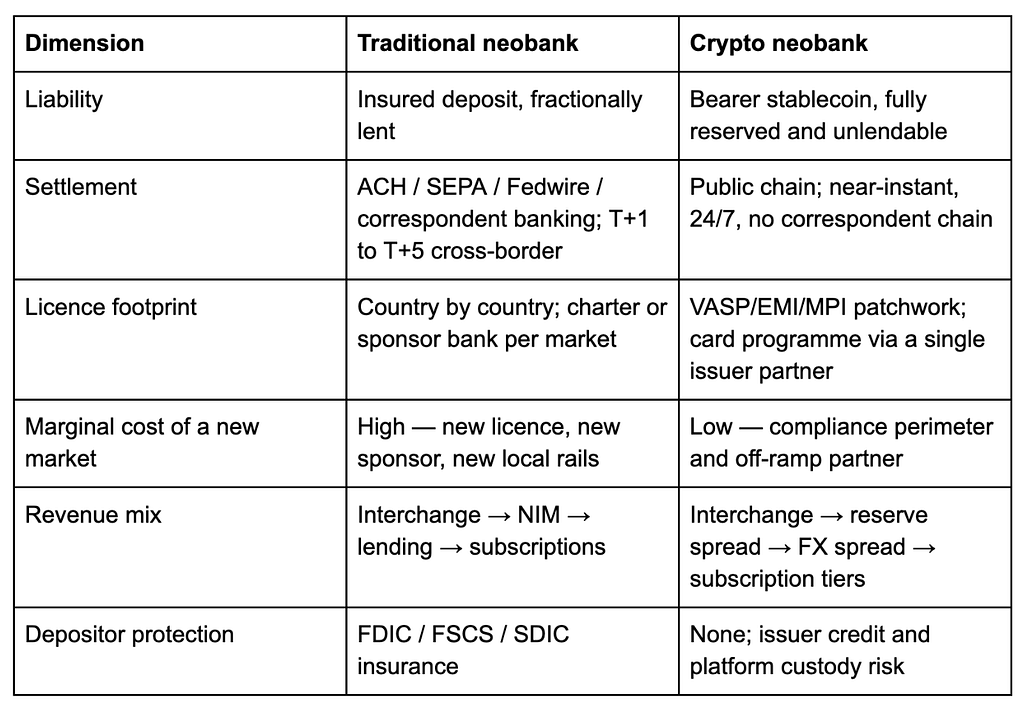
The licence determines the legal claim a customer holds, whether the provider can use customer money to fund credit, and what protection applies if the firm fails. The same app interface can therefore sit on very different regulatory foundations.
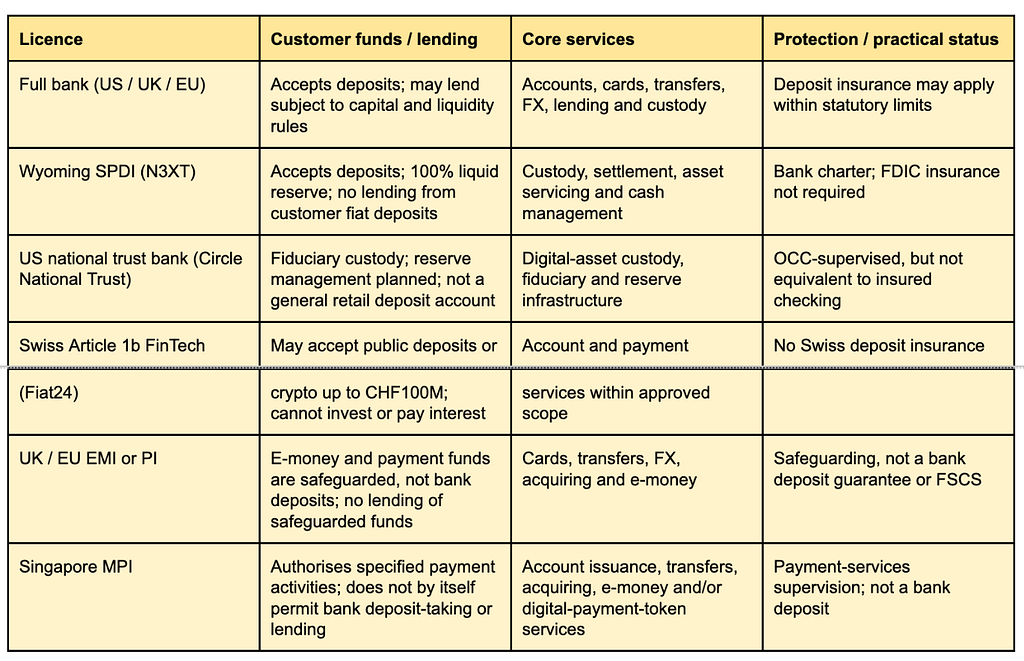
The table explains why product menus alone are misleading. N3XT is legally a bank even though its model looks like a settlement network and it does not lend. Circle National Trust is a federally supervised trust bank, but it is not a general-purpose retail deposit bank. Fiat24 delivers an account, IBAN and card under a narrower Swiss FinTech licence. Payment-led apps can offer more corridors or card coverage than a limited-purpose bank, but a payment licence does not by itself create an insured deposit or a balance sheet that can fund loans.
3 Structural Advantages for Crypto Neobanks
Theme 1: Global Reach With Lower Marginal Expansion Costs
Crypto neobanks turn geographic expansion from a country-by-country infrastructure build into a reusable operating stack. Once card issuance, stablecoin settlement, compliance and local conversion partners are in place, the same core product can extend across new corridors without replicating a full local banking balance sheet. KAST’s reported reach across more than 190 countries within roughly 18 months illustrates the model’s speed and capital efficiency.
At the payment layer, crypto neobank with native stablecoin support benefit from lower processing costs of 0.5%-1.5%, versus 2.5%-3.5% for traditional card processing, with network fees below $0.01 on many low-cost chains. Combined with 24/7 settlement and less dependence on correspondent banks, that gives crypto neobanks more room to price competitively, monetize FX and payment flows, and enter underserved corridors without costs rising in line with country count.
Theme 2: Cross-Border Working Capital and the Prefunding Constraint
A traditional neobank serving cross-border B2B must pre-position local currency in every corridor it supports. Those balances are corridor-specific, sized to peak expected outflow rather than average, and earn little. Estimates of total idle prefunded liquidity in nostro and vostro accounts range from roughly $5 trillion to $27 trillion depending on methodology, with the higher figure attributed to the BIS. Stablecoin rails change the shape of the requirement rather than the speed of the payment. A single dollar-denominated pool serves every corridor, converted at the point of payout through a local liquidity partner instead of parked in advance. Working capital stops scaling linearly with coverage. And because settlement is continuous rather than gated by clearing windows and Friday cut-offs, the same float turns over more times per week — the two effects compound.
Where crypto neobank and traditional neobank compete directly, the crypto neobank holds a real cost advantage it can bank as margin or spend on price. More importantly, it can underwrite corridors a traditional neobank cannot justify — thin, volatile or low-volume routes where the prefunding buffer would never be recovered.
Theme 3: Programmable Accounts and New Revenue Layers
Account-based finance is built around a KYC’d legal person. An autonomous agent cannot open a bank account, pass a credit check or sign a SaaS contract, but it can sign a transaction. A crypto neobank issuing genuine smart accounts — rather than ledger entries inside an omnibus custody structure — can delegate scoped, revocable, cryptographically enforced spending authority to software without that software becoming a legal customer. That is an architectural difference rather than a product feature, and it is the part traditional neobanks cannot reach by integrating a partner.
The economics reinforce it at the low end. Card interchange carries a fixed-fee floor that makes sub-cent machine-to-machine settlement structurally unviable; x402’s average ticket is $0.31 across roughly 69,000 active agents. Per-inference, per-call and per-data-feed payments have no card equivalent, and that workload — not agent-to-merchant retail purchasing — is where the category’s defensible position sits. Agent-buys-from-merchant is being claimed by the networks, which own dispute resolution and merchant acceptance.
Future Outlook
Crypto neobanks are positioned to evolve from card-led products into the operating account for a global digital economy. The near-term opportunity begins with consumers and businesses already living across currencies: remote workers, exporters, online merchants, globally distributed teams and users in markets where access to stable money is limited. By combining local account details, cards and familiar bank transfers with 24/7 stablecoin settlement, crypto neobanks can capture salary, savings, merchant receipts and supplier payments within one relationship. Each additional flow strengthens the account’s utility and creates multiple revenue pools across FX, payments, subscriptions and treasury services.
The corporate market offers the clearest path to scale. Businesses that pay contractors and suppliers across several countries still face fragmented bank accounts, cutoff times and corridor-by-corridor prefunding. A stablecoin-based account can pool liquidity, convert at the point of payout and rebalance continuously, improving working-capital efficiency while opening corridors that were previously too expensive or operationally complex to serve. Layering payroll, invoicing, mass payouts, corporate cards, team permissions and treasury automation onto that account can turn crypto neobanks from payment providers into embedded financial operating systems. Because these workflows are recurring and deeply integrated, they can support larger balances, higher transaction volumes and more durable customer retention than a consumer card alone.
Over time, programmable accounts can expand the market beyond human users. Smart accounts can allow verified businesses and individuals to delegate precise, revocable spending authority to software, enabling agents to earn revenue, buy data and compute, pay for APIs and settle machine-to-machine transactions continuously. Crypto neobanks that provide the secure account, identity, policy and settlement layer for these activities can capture transaction fees, software subscriptions and platform revenue from an entirely new class of financial activity. As regulation matures and stablecoin infrastructure becomes embedded across banking and payments, the category’s strongest platforms will combine global distribution with trusted custody, liquidity and compliance. Their opportunity is to make stablecoins increasingly invisible and useful: the default account layer for global consumers, businesses and autonomous agents. The first generation made stablecoins spendable; the next can make them foundational.
References
- Spark, “Neobank Business Models: How Challenger Banks Actually Make Money”
- DL News, “Why crypto’s biggest firms are jumping on the neobank trend” — https://www.dlnews.com/articles/web3/why-crypto-neobanks-are-becoming-popular/
- Messari / Sam (@0xCryptoSam), “The Anatomy of a Crypto Neobank” — https://x.com/0xCryptoSam/status/1998421011352498535
- Bankless, “The Crypto Neobanking Surge” — https://www.bankless.com/read/crypto-neobanks
- Antier, “Top Crypto Neo Banking Trends To Watch Out For In 2026” — https://www.antier.com/blogs/top-crypto-neo-banking-trends-to-watch-out-for-in-2026/
- Sammy’s Snippets, “The Agentic Future: Neobank Customers are no Longer Just Human” — https://www.0xsammy.com/p/the-agentic-future-neobank-customers
- McKinsey, “Stablecoins in payments: what the raw transaction numbers miss” — https://www.mckinsey.com/industries/financial-services/our-insights/stablecoins-in-payments-what-the-raw-transaction-numbers-miss
- McKinsey, Global Banking Annual Review 2025 — https://www.mckinsey.com/industries/financial-services/our-insights/global-banking-annual-review-2025
- McKinsey, Global Banking Annual Review 2026 — https://www.mckinsey.com/industries/financial-services/our-insights/global-banking-annual-review
- Visa Onchain Analytics — https://visaonchainanalytics.com/transactions
- Circle, “Final OCC approval for Circle National Trust”
- Circle, “2025 Form 10-K”
- N3XT, “About and FAQs”
- Dealroom.co, “Blockchain bank N3XT raises $72M across three funding rounds”
- Fiat24, “Products and account services”
- Fiat24, “Legal terms”
- FINMA, “FinTech licence guidelines under Article 1b”
- Wyoming Division of Banking, “Special Purpose Depository Institutions”
- Bank of England, “New Bank Start-Up Unit”
- FCA, “Using payment service providers”
- ECB, “Lists of financial institutions”
- MAS, “Major Payment Institution directory”
【免责声明】市场有风险,投资需谨慎。本文不构成投资建议,用户应考虑本文中的任何意见、观点或结论是否符合其特定状况。据此投资,责任自负。
来源链接